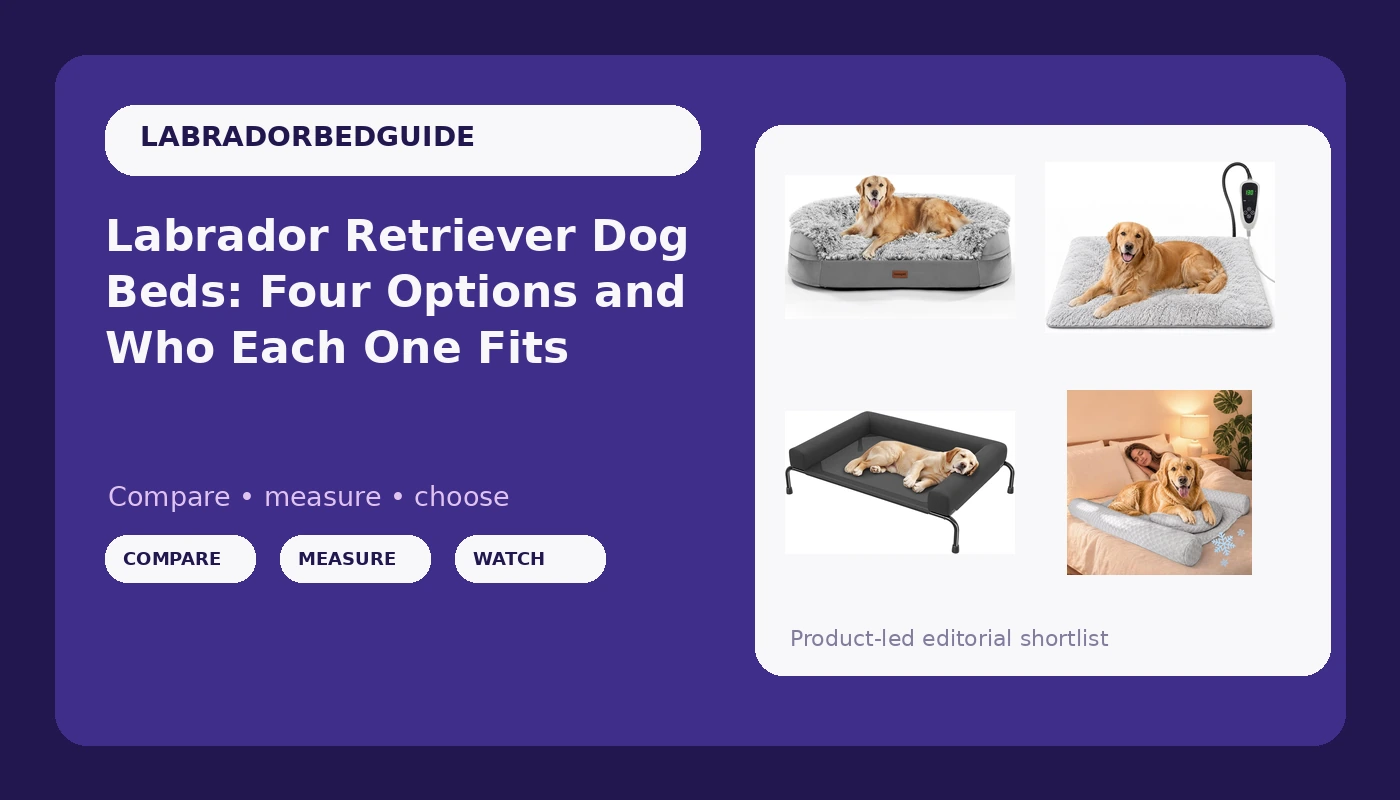
Labradors are not a one-size-fits-all dog when it comes to sleep. A 75 pound field lab sprawls flat with his legs out in every direction, and a medium bed turns into a nightly negotiation. A senior lab with stiff hips needs real support and an easy way to step on and off. A puppy will treat anything soft as a chew toy until he is past the shark phase. That is why Labrador retriever dog beds are less about crowning a single winner and more about matching a bed to the dog currently living in your house. The four options below cover four different jobs: a cushioned floor bed, an elevated cot, a heated pad, and a bedside bed. Every detail comes from the product listings, and the trade-offs are spelled out so you can decide with your own tape measure.
Related: Measuring a Labrador for a Bed: Nose to Tail Plus Twelve Inches →
Quick answer
Match the bed to how your lab sleeps and how old he is, not to the word on the label. A lab that sprawls on the floor does well with a cushioned 44 inch bed that has a removable, washable cover. A lab that runs hot or chews fabric needs an elevated cot with bolsters, because there is less material to destroy and more airflow underneath. A senior lab with stiff hips benefits from a heated pad layered on the bed he already uses. A lab that presses against your mattress all night is a candidate for a bedside bed of his own. No fabric bed in this group is described as indestructible, because no fabric bed is.
Four useful options
| Model | Best fit | What stands out |
|---|---|---|
| iweepet Fluffy Calming Orthopedic Dog Bed | Labs that sprawl and need a cushioned floor bed | 44 in size class, 3.7 in egg-crate foam listed as 28D, removable washable plush cover, waterproof lining |
| Simple Trending Elevated Dog Bed with Bolsters | Labs that run hot and need airflow | Elevated design with bolsters, black, sized for large dogs |
| GOLOPET Extra Large Dog Heating Pad | Senior labs, stiff hips, and cold rooms | 47x30 in, smart thermostat switch, power line protection tube, MET and UL dual certification, waterproof with velvet cover |
| JoyBlooms Dog Bed for Human Bed | Labs that sleep pressed against the bed | Built for use on or beside a human bed |
The cushioned floor bed: iweepet Fluffy Calming Orthopedic Dog Bed
The trade-off here is the plush. A soft cover is exactly what a senior lab wants under his elbows, and it is exactly what a lab under three years old wants to shred. If your dog is still in the phase where every soft thing gets a test bite, this bed needs supervision or a different home until he settles. The second thing to check is foam. Density labels are written in different conventions, so compare the listed specification against how the bed feels under your own hand and how it recovers after your lab stands up. A removable cover is the single most valuable feature in this category, because a bed that cannot be washed becomes a bed you replace.
The airflow cot: Simple Trending Elevated Dog Bed for Large Dogs with Bolsters
An elevated cot solves two Labrador problems at once. Air moves under the sleeping surface, which matters for a double-coated dog in a warm room, and there is no thick foam layer to pull out and spread across your floor if your lab decides the bed is a project. The trade-off runs the other way for older dogs. A taut suspended surface is firmer than a foam sofa bed, and a lab with hip dysplasia may need a mat or a blanket on top before he will commit to it. If your dog has never used an elevated bed, place it where he already naps and let him choose it rather than lifting him onto it.
The warmth layer: GOLOPET Extra Large Dog Heating Pad
This is a layer, not a bed, and that distinction keeps people from wasting money. Buy it to put on top of a foam bed or a cot for an older lab whose joints stiffen overnight, or for a dog who sleeps in a cold room or a garage-adjacent space. The thermostat switch matters because a fixed-temperature pad gives you no way to dial things back, and the power line protection tube matters in a house with a chewer, though no cord should ever be left where a determined lab can reach it. I am a trainer, not a vet, so treat heat as comfort and not as treatment. Follow the manufacturer's instructions on use and supervision.
The bedside bed: JoyBlooms Dog Bed for Human Bed
Most labs I have lived with end up leaning against the side of the bed rather than taking over the middle, and this kind of bed acknowledges that habit. The limitation is obvious once you picture a 75 pound dog: a bedside bed is a companion surface, not a replacement for a full floor bed where he can stretch out like a starfish. It is also not a durability play. If your lab is a chewer, this is a bed for a dog who has already earned the privilege of sleeping near your furniture.
Prices and availability may change. Product images, names, and retailer links are matched to verified listings. No current price, rating, stock status, or measured result is stated here without current evidence.
How a Labrador actually sleeps in a bed
Watch your dog for one full night and you will learn more than any product page will tell you. Labs sprawl. They do not curl into a donut the way a smaller breed does, which means the useful measurement is length, not width, and the useful shape is a flat sleeping area rather than a deep nest. The measurement rule I use is nose to tail plus twelve inches, taken while the dog is stretched out on the floor. That extra foot of space is what stops a lab from hanging off the edge and waking up stiff.
Listing sizes are where most people get burned. The word large on a dog bed listing can mean anything from a 40 pound dog to a 90 pound dog, and the dimensions in the description are the only honest number on the page. Measure your lab, then measure the bed. If a listing gives a 44 inch length and your dog measures 38 inches nose to tail, the math works with room to spare. If your dog measures 42 inches, keep looking or accept that he will sleep with his head on the floor. Bolsters and raised edges are a comfort feature for a dog who likes to rest his chin, and a nuisance for a dog who wants to lie flat in every direction.
Foam density, chew timelines, and cost per day
Foam is the part of a bed you cannot see, which is why it is where the money quietly disappears. Density is usually expressed in pounds per cubic foot, and a low number means the foam compresses under a 75 pound lab within a few months and stops coming back. Egg-crate foam is a shaping choice, not a density rating, so a bed can have a sculpted top layer and still be soft underneath. When you shop, look for the stated density, then judge the bed by how quickly it springs back after your dog stands up. A bed that stays dented is on its way to being a pancake.
The other number that matters is cost per day. Divide what you paid by how many days the bed actually lasts. A cheap bed that flattens in four months is not cheaper than a better one that holds its shape for years, it just bills you in installments. And for labs under three years old, the honest framing is different: you are not buying a bed, you are buying a chew timeline. Soft covers, thick foam, and loose stuffing are all fair game during the shark phase. A cheap bed now and a serious bed later is the arithmetic that actually saves money. Redirecting the chewing is the real fix, because a lab chews because chewing is what labs do, and your job is to make the bed boring and the chew toy interesting.
- Measure your lab nose to tail while he is stretched out, then add twelve inches.
- Compare that number against the listed bed dimensions, not against the size word on the label.
- Decide whether he needs a flat floor bed, an elevated cot, or a bedside surface based on where he already sleeps.
- If he is a senior or shows stiffness, prioritize support and consider a heated layer over the bed.
- Check that the cover comes off and survives a washing machine before you order, because zippers and seams fail first.
Practical guidance before you order
- Keep the bed in a spot your lab already chooses for naps, because dogs rarely adopt a bed placed in a strange corner.
- Put a worn t-shirt or blanket on the new bed for a few days so it smells like home rather than like a warehouse.
- Wash the cover on the schedule the manufacturer gives, and check the zipper after every wash, since that is the first failure point.
- If you are layering a heated pad, run the cord where it cannot be reached and follow the listed instructions for supervision.
- Buy for the dog you have today. A twelve week old puppy and an eleven year old lab need different beds, and buying one bed for both stages usually means buying twice.
Which option should you choose?
Choose the iweepet Fluffy Calming Orthopedic Dog Bed when your lab sprawls on the floor and you want a cushioned surface with a cover you can actually wash. Choose the Simple Trending Elevated Dog Bed with Bolsters when your dog runs hot, sheds heavily, or has already shown you what he does to soft fabric. Choose the GOLOPET Extra Large Dog Heating Pad when you have an older lab with stiff hips or a cold sleeping area, and you want to add warmth to a bed he already uses. Choose the JoyBlooms Dog Bed for Human Bed when your lab spends the night pressed against your mattress and you want him to have his own space beside it.
One caveat applies to all four: these descriptions come from the product listings, not from a laboratory, and fit depends on your individual dog. A bed that works for a calm eleven year old rescue may not survive a two year old field lab for a month. Read the current listing details before you buy, and treat any claim of indestructible as marketing until your own dog has tested it.
The bottom line
There is no single bed that solves every Labrador. The right approach is to measure your dog, match the bed to how he sleeps and how old he is, and spend where it counts: support for a senior, airflow and less fabric for a chewer, washability for everyone. The iweepet bed covers the sprawling floor sleeper, the Simple Trending cot handles heat and chewing, the GOLOPET pad adds warmth for stiff joints, and the JoyBlooms bed gives a clingy sleeper his own spot near yours. Buy the one that fits the dog in front of you, and check current Amazon price and availability before you commit, because listings change and dogs do not.