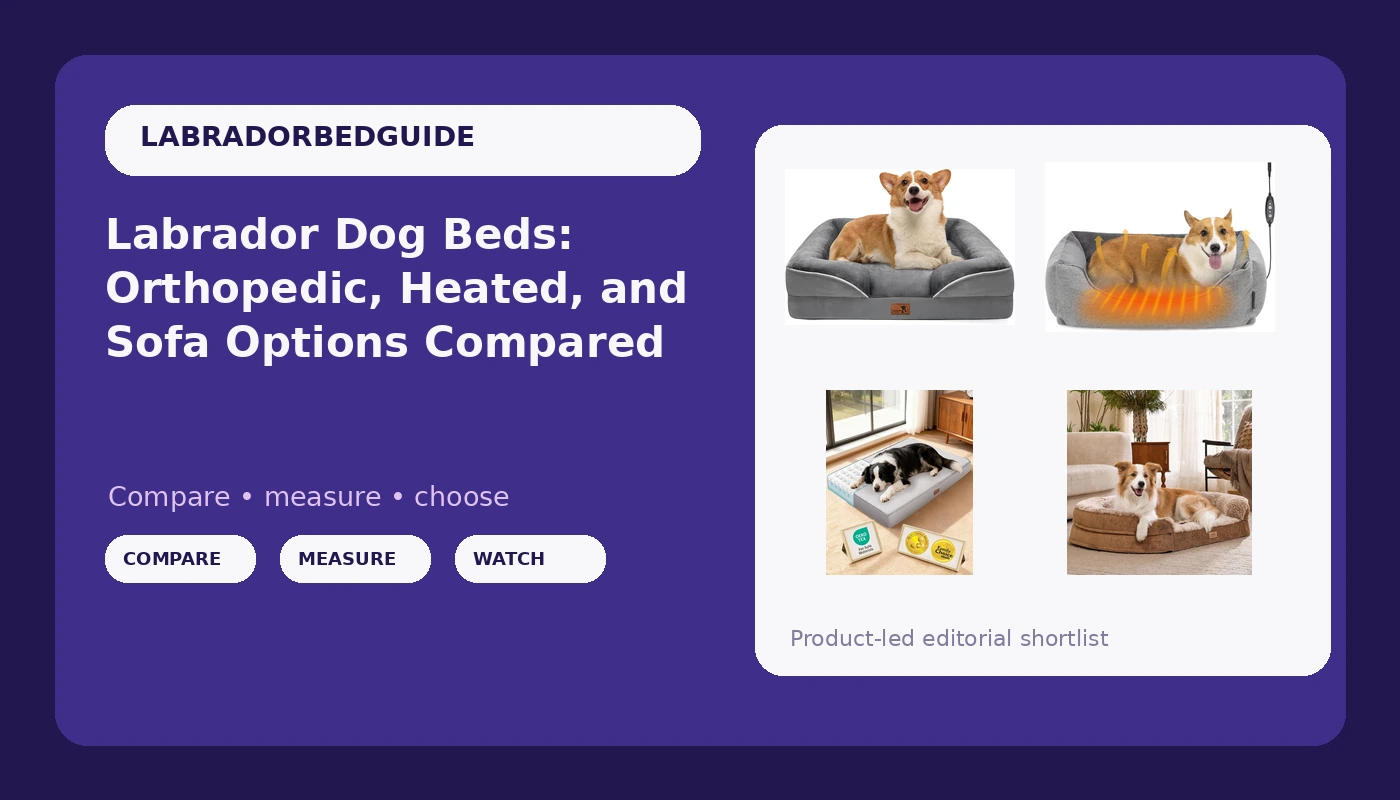
Labs do not sleep curled in a tidy ball. They sprawl, legs out, taking up more floor than the bed they were sold. That is the first thing to understand when you shop for orthopedic dog beds for labradors: the word on the box and the dog on your floor are often two different sizes. Add a breed that carries serious weight on its hips and a jaw that treats stitching like a chew toy, and fit, foam, and cover construction start to matter more than the shape of the thing. The four beds below cover the range most lab owners actually need: a medium sofa with sides, a heated sofa pad, a 36-inch memory foam bed, and a 37.4-inch orthopedic couch.
Related: How to Measure a Labrador for a Dog Bed →
Quick answer
Match the bed to your lab's current weight and sleep posture, not to the word "large" in the listing. A lab that stretches out flat needs an interior length longer than nose-to-tail, while a lab that leans against a bolster does fine with a sofa style. Foam density, a removable washable cover, and honest interior dimensions decide how long a bed survives. A heated pad helps a stiff senior on a cold floor, but it adds a cord, and a cord is a chew target. None of these four listings is a chew-proof bed, so treat all of them as wrong for a lab in the shark phase unless the bed lives in a crate or under supervision.
Four useful options
| Model | Best fit | What stands out |
|---|---|---|
| Spotted Play Orthopedic Dog Bed with Sides, Grey, size M | Medium dogs and leaners | Raised sides, removable washable cover, waterproof lining, non-slip bottom |
| Heated Dog Bed with Auto Sensing Heated pad | Cold sleepers and stiff seniors | Auto-sensing heat, three temperature settings, chew-resistant cord |
| OhGeni Orthopedic Waterproof Med Large Dog Bed, 36 inch | Mid-size labs, waterproof needs | Memory foam, 36-inch footprint, waterproof construction |
| FUKUMARU Dog Bed, 37.4-Inch Large Orthopedic Dog Couch | Larger labs within the weight rating | 37.4-inch couch length, orthopedic build, listed up to 55 lb |
The medium sofa with sides: Spotted Play Orthopedic Dog Bed with Sides
The catch is in the size letter. This one is listed as a medium bed for medium dogs, which means it fits a smaller adult lab or an adolescent that has not finished filling out, not a 75-pound male at full stretch. The removable cover and waterproof lining are the parts worth paying attention to: a lab that comes in wet from the yard or drools on the bolster will test both, and a cover that survives repeated washing is the difference between a bed that lasts and a bed you throw out because it smells. Bolsters also change how a dog uses a bed. Some labs press into a corner and rest their chin on the raised edge, and others ignore bolsters entirely.
The heated sofa pad: Heated Dog Bed with Auto Sensing Heated pad
Heat is a comfort feature, not a durability feature, and it is worth saying plainly that a heated bed and a chewer are a bad combination unless the cord is fully out of reach. Labs with hip dysplasia often seek out warm spots on their own, so a heated pad can be a sensible addition for an older dog that stiffens up overnight. The chew-resistant cord is a meaningful detail because the cord, not the foam, is what usually fails first on heated products. Read that as a reduced risk, not a guarantee. If your lab is under three years old, this is not the bed for that dog.
The mid-size memory foam option: OhGeni Orthopedic Waterproof Med Large Dog Bed
Memory foam is a category, not a specification. The number that matters is density, usually expressed in pounds per cubic foot, and it is frequently missing from listings. Low-density foam feels soft in the store and pancakes under a heavy dog within months, which is exactly how a bed that seemed like a bargain becomes an annual expense. If you cannot find a density figure, look for a bed with a long warranty and a cover you can remove, because at least then you are only replacing foam rather than the whole bed. The 36-inch footprint here is the other thing to check against your own measurement, since it sits below the couch length of the largest option on this list.
The large orthopedic couch: FUKUMARU Dog Bed, 37.4-Inch Large Orthopedic Dog Couch
That 55-pound rating is the honest kind of size claim, and it deserves a straight answer: a female lab at 55 pounds sits right at the limit, and a male lab at 75 pounds is past it. A bed rated below your dog's weight will compress faster and wear out sooner, no matter how good the foam is. What this listing does offer is the longest footprint here, plus a couch profile that supports a dog that likes to drape its head over an edge. If your lab is at or under the rating and you want one bed that fits a sprawler, this is the shape to measure against.
Prices and availability may change. Product images, names, and retailer links are matched to verified listings. No current price, rating, stock status, or measured result is stated here without current evidence.
Why cover construction decides how long a lab bed lasts
Foam gets the marketing attention, but covers and zippers decide whether you keep the bed. A lab's coat carries oils, dirt, and water, and a bed that cannot be washed will smell long before it flattens. Look for a cover that unzips completely rather than one with a small opening, and look for a waterproof lining underneath, since a liner that fails lets moisture into the foam itself. Zippers are the part that breaks first on most beds, usually after a dozen or so washes, and a broken zipper turns a washable bed into a permanently dirty one. Raised sides and bolsters add another failure point, because stitching on a seam is exactly what a bored adolescent lab chews.
There is also a behavior piece here that no material fixes. Chewing is normal in young labs, and it is not a statement about your bed. The practical approach is to make the bed boring and the chew toy interesting, and to accept that a lab in the shark phase will eventually find any exposed seam. That is why the recommendation for a lab under three years old is different from the recommendation for a settled adult: cheaper and replaceable now, denser and more expensive later.
How to size a bed for a Labrador
- Measure your lab nose to tail while it is lying flat, not standing. Lying length is the number that matters.
- Add roughly 12 inches to that measurement for a sprawler, and less for a dog that curls or leans.
- Check the interior dimension of the bed rather than the outer shell, since bolsters and couch edges eat into usable space.
- Weigh your dog today, and remember that a lab under two years old is still adding pounds, so do not buy to the current number alone.
- Look for a foam density figure in pounds per cubic foot and a warranty long enough to cover a heavy dog, and treat a missing density spec as an unknown.
Practical guidance before you buy
- Take the cover off and wash it before the first use, so you learn how the zipper behaves while the bed is still returnable.
- Keep a heated bed's cord routed behind furniture or under a rug edge, out of the path a lab patrols.
- Put a new bed inside a crate for the first few weeks with a young lab, so the bed is not the most interesting chewable object in the room.
- Flip or rotate foam periodically to even out compression, especially on the end where your dog's shoulders land.
- Keep the packaging and the order details until you have confirmed the interior dimensions match your measurement.
Which option should you choose?
Choose the Spotted Play Orthopedic Dog Bed with Sides when you have a medium-size lab or an adolescent that leans into bolsters, and you want a washable cover with a waterproof lining. Choose the Heated Dog Bed with Auto Sensing Heated pad when you have an older lab that stiffens in a cold room and you can keep the cord away from teeth. Choose the OhGeni Orthopedic Waterproof Med Large Dog Bed when you want memory foam and a waterproof build in a 36-inch footprint for a mid-size lab. Choose the FUKUMARU Dog Bed, 37.4-Inch Large Orthopedic Dog Couch when your lab is within the stated 55-pound rating and you want the longest couch-shaped bed of the group.
The limitation worth repeating: sizing, foam density, and cord construction vary by listing, and none of these four products is marketed or verified here as chew-proof. Verify the interior dimensions and any foam specification on the current listing before you commit, and treat any weight rating as a ceiling rather than a suggestion.
The bottom line
For most adult labs, the honest decision comes down to two numbers and one material. Measure your dog lying flat, add room for the sprawl, and buy to the interior dimension rather than the size letter. Then look at the cover and the foam, because that is where the money goes. A medium sofa with sides and a waterproof lining suits a compact lab that likes to lean, a heated pad suits a stiff senior in a cold room, a 36-inch memory foam bed suits a mid-size sleeper that needs waterproofing, and a 37.4-inch orthopedic couch suits a lab inside the 55-pound rating that wants the most floor space. If your lab is still in the chewing years, spend less now and save the dense foam for the dog that has stopped auditioning every seam in the house.