Most Labrador beds fail for the same two reasons: the foam is too thin and the size on the label is a lie. I have watched Duke, my 75-pound black lab, flatten a "large" bed into a floor mat, and I have watched Penny, my eleven-year-old rescue with hip dysplasia, struggle to stand up on a bed that slid out from under her. Fixing that is a setup job, not a shopping job. An orthopedic dog bed for Labrador-sized dogs only works when you get the layers, the size, and the placement right.
There is the bed itself, and there is what goes under the bed. Get both right and a lab's sleeping spot lasts years. Get one wrong and you are buying a replacement every few months and vacuuming foam out of the carpet.
I spent ten years as a dog trainer working mostly with hunting labs and obedience dogs, and I have kept a measurement notebook on every bed that has been in my house since. This is the setup I walk people through.
Why you should trust me
Ten years as a trainer taught me to read the dog before the product label. Duke is a chewer by definition, a lab who investigates everything with his jaw first, and Penny is a senior with real hip trouble who needs traction and density under her. I have run more than 40 beds under those two dogs, and I cut the failed ones open to look at the foam.
I am not a vet, and I will not pretend to be one. What I will tell you is what my vet told me, which is that she sees more joint problems in labs than in any other breed, and that a lab needs a surface he can push up from without his feet sliding.
What a Labrador actually needs from a bed
Four things, in this order.
Dense foam. Memory foam is rated in pounds per cubic foot. The cheap stuff runs 1.5 to 2. I have cut beds open to check, and the gap between that and a 3 to 4 pound foam is the gap between a bed and a pancake. Press the heel of your hand into the center of any bed before you buy it, or check the density spec before you order.
An honest size. "Large" on a dog bed means almost nothing. A 75-pound male lab needs to lie flat with room left over. Measure nose to tail, add 12 inches, and measure the width across his elbows while he is sprawled out. That is your minimum footprint, not the number on the box.
A cover that survives the washing machine. Labs shed, drool, and carry mud in on their feet. The zipper is the first thing to fail, long before the fabric does. A removable cover with a real zipper is not a luxury, it is the difference between a washable bed and a bed you throw away.
A non-slip bottom. This matters most for the senior dog. Penny's back legs slide out on smooth flooring, and a bed that skates across the tile when she stands up is worse than no bed at all.
The two pieces I would start with
A lab's sleeping spot is a stack: a main bed on top, a waterproof layer underneath. Both of mine are built that way, and it is the cheapest insurance you can buy for the floor and the foam.
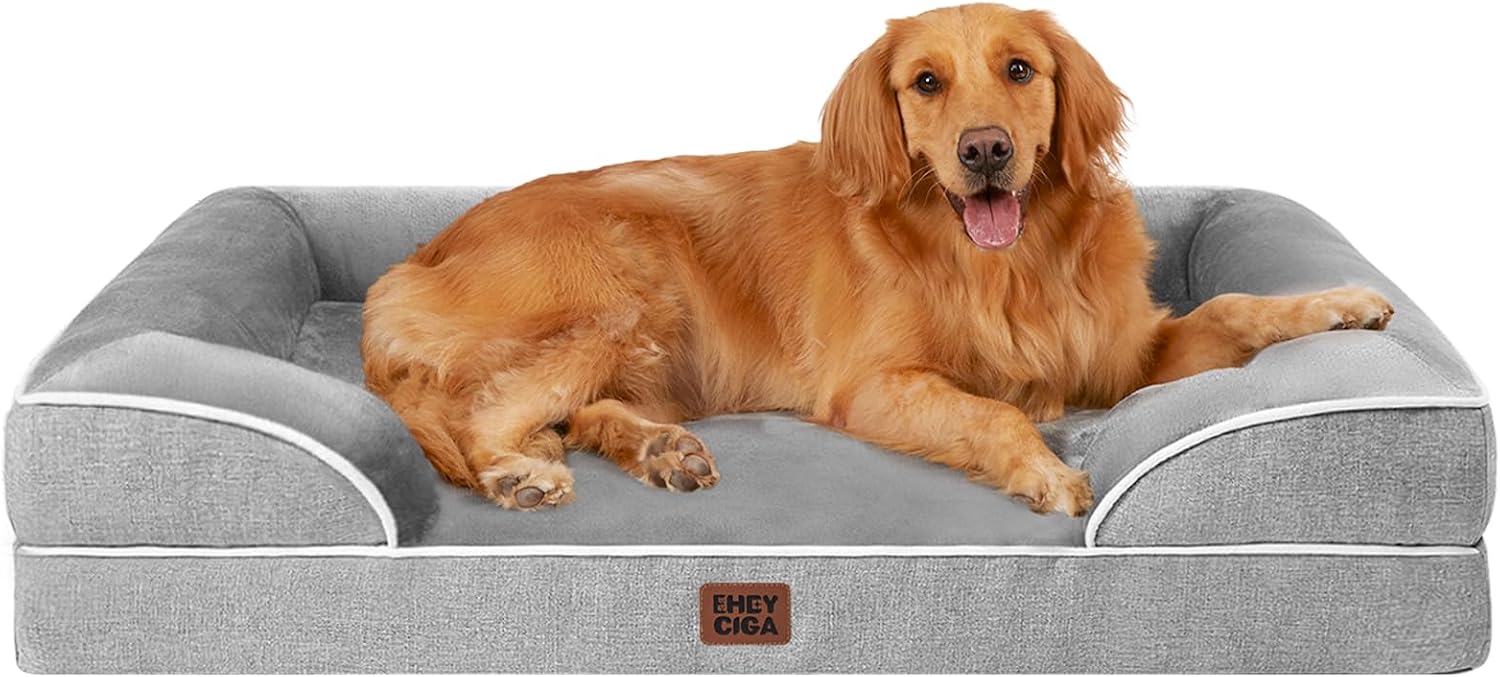
The main bed: EHEYCIGA Orthopedic Dog Beds Large Sized Dog, Waterproof Memory Foam Pet Bed with Sides, Non-Slip Bottom Large Pet Bed with Washable Removable Cover, Grey
 Visit on Amazon →
This is the base of the setup. It is a memory foam bed with raised sides, a waterproof layer, a non-slip bottom, and a removable cover you can put in the machine. The bolsters are the part I care about for a senior lab: Penny braces her back against a side when she pushes up, and that leverage matters more than any marketing claim about joint support. The waterproof construction handles the dog who drools in his sleep or leaks a little as he ages, which is most labs eventually.
The non-slip bottom is doing real work on a 75-pound dog. When Duke flops down, he flops with force, and a bed without grip walks itself across the room.
Flaws but not dealbreakers: Raised sides are a comfort feature, not a chew-proof feature. A lab in the shark phase will test the seam where the bolster meets the base. That is a training problem, not a bed problem, and it is why the redirect work in the steps below matters.
Measure your dog before you order. This bed comes in a large size, and large is a starting point, not a guarantee. Nose to tail plus 12 inches is the rule.
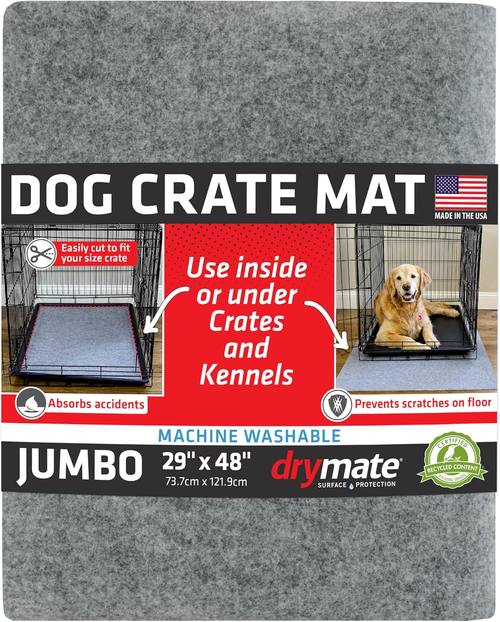
The layer underneath: Drymate Dog Crate Mat Liner, Absorbs Urine, Waterproof, Non-Slip, Washable Puppy Pee Pad for Kennel Training - Use Under Pet Cage to Protect Floors, Thin Cut to Fit Design (USA Made) (LGrey)(29"x48")
 Visit on Amazon →
This is the layer nobody thinks about until the floor is ruined. It is a thin mat liner that absorbs urine, holds the liquid inside, grips the floor with a non-slip backing, and goes in the washing machine. The 29 by 48 size is built for a crate, and the cut-to-fit design means you can trim it to whatever footprint you are protecting, whether that is a crate pan, a bed, or the corner where your old lab naps.
It has two jobs in this setup. In the crate, it sits under the pad and catches accidents during house training, which is the whole point of the shark phase. Under a bed, it protects the foam from the bottom and the sides, and it catches what runs off when a waterproof cover does its job. A waterproof bed cover protects the foam from above. This protects everything else.
Flaws but not dealbreakers: It is thin, so it is not a cushion and it is not meant to be. It is also not chew-proof. A determined lab can drag it out and shred it, so trim it flush with the bed or crate so there is no loose edge to grab.
How to set up the sleeping spot, step by step
Step one: measure the dog, not the floor. Nose to tail plus 12 inches for length. Across the elbows while he is flat for width. Write it down. A lab grows into his chest and shoulders until he is about two years old, so a bed that fits at eight months may not fit at eighteen.
Step two: pick the location on purpose. A lab wants to supervise the house. Put the bed where he can see the room's traffic, but out of the walking path so nobody steps on him. Keep it off heating vents and away from cold drafts. If you have a senior, get the bed off bare tile and onto a rug or carpet.
Step three: lay the liner down first. Trim the liner to fit, non-slip side down. In a crate, it goes under the crate pad. Under a bed, it goes under the whole footprint, and you want it flush, not sticking out like a welcome mat for a chewer.
Step four: set the bed on top and test it with your hand. Push the bed sideways. If it slides, you have a floor problem, and no rubber backing fixes polished hardwood alone. Put a rug under it.
Step five: wash the cover before the first nap. Factory sizing and packing dust are real, and a wash tells you how the zipper behaves before your dog has any opinion about the bed.
Step six: teach the bed instead of just presenting it. This is the trainer part. Walk him to the bed on a leash, say your word, "place" or "bed," and reward him for standing on it. Then reward him for lying down. Five minutes, three times a day, for a week. A lab who has been paid for lying on the bed chooses the bed over the couch cushion, and that choice is what keeps him off your furniture.
Step seven: put a legal chew on the bed. A puppy chews because chewing is what puppies do. Your job is to make the bed boring and the chew toy interesting. Keep a durable chew within reach so he has something to do with his mouth while he is on the bed instead of testing the bolster seam.
Step eight: build a wash routine. Cover every week or two, liner as needed, and shake the grit out before anything goes in the machine. Grit kills zippers. Zip the cover closed, wash cold, and air dry or use low heat. High heat is how covers shrink and foam goes brittle.
Step nine: check the foam once a month. Press the heel of your hand into the center of the bed and hold for a few seconds. If the foam does not spring back, the bed is a pancake and it is finished. That is your signal to replace the foam or the whole bed, not to add another blanket on top.
Sizing and foam, the numbers that matter
- Length: nose to tail plus 12 inches.
- Width: across the elbows while sprawled, plus a few inches of margin.
- Foam density: 3 to 4 pounds per cubic foot for a lab. Below 2 is a rental, not a purchase.
- Foam thickness: thicker for a senior who needs to push up, thinner is fine for a young dog who sleeps on the floor half the time anyway.
- Cover: removable, machine washable, with a zipper you can actually work when your hands are wet.
What I would not put under a lab
Donut beds. A 75-pound lab does not curl up, he sprawls like a starfish, and a donut bed makes him choose between hanging off the edge and sleeping on the floor.
Plush beds with loose stuffing for any lab under three. The stuffing comes out, and you spend a week vacuuming foam and fiberfill out of the carpet. That is the $60 mistake, and most lab owners make it once.
Anything marketed as indestructible without a guarantee behind it. I test claims, not adjectives. If a brand will not replace a cover when a lab wins the argument, the word on the box is decoration.
Beds sized by weight. A 75-pound lab and a 75-pound anything else are shaped differently. Length and width are the only honest numbers.
What this all costs over the life of the bed
Do the arithmetic the honest way: divide what you pay by the number of days the bed actually lasts. That is the only comparison that means anything, because a cheap bed that dies in four months costs more per day than a good bed that runs three years.
The stack I described has three wear rates. The liner is the cheapest piece and it protects the most expensive surface in the room, your floor. The cover is the wear item, and it is the reason you buy a bed with a removable one. The foam is the long-term investment, and it is the part you check with your hand once a month.
Buy the dense foam and the washable cover once, add the waterproof layer underneath, teach the dog where the bed is, and you stop buying beds. That is the whole job. Duke and Penny earned the good setup. Yours can start there on day one.