Most dog beds sold to Labrador owners fail for one of three reasons. The foam pancakes in four months. The cover shreds in four weeks. Or the size is a lie, and a 75 pound male sleeps with his elbows on the crate pan and his chin on the floor.
I have replaced enough of them to know the pattern. A dog bed for a Labrador is a different product than a dog bed for a 20 pound spaniel, and most of the market is built for the spaniel. Duke is 75 pounds of black lab who chews first and asks questions later. Penny is 55 pounds, 11 years old, and carries hip dysplasia into every nap. Whatever is on the floor in this house has to survive both of them.
The good news is that the setup matters as much as the bed. Here is how I size, place, and set up a Labrador bed so you buy it once instead of four times.
Why you should trust me
I spent 10 years as a dog trainer, most of it with hunting labs and obedience dogs, and kennel owners destroy gear faster than any family home I have ever worked in. Now I write reviews full time from Ohio, with Duke (75 pounds, 5 years old) and Penny (55 pounds, 11 years old, rescue, hip dysplasia) under my desk while I work.
I have had more than 40 dog beds through this house. I keep a notebook: foam sink depth, chew timelines, the week a zipper died, whether the cover survived the wash cycle. The bedding industry sells adjectives. I measure things, and I have cut beds open to check what the foam actually is instead of what the label says.
Two boundaries up front. I am a trainer, not a vet. I will tell you what my vet told me about Penny's hips, but I will not diagnose your dog. And I do not recommend a "chew-proof" product I have not watched a real chewer work on.
How I picked and how I tested
I am not going to pretend I slept on these two beds for a month. What I can give you is the checklist I run on every bed that comes into this house, and the two products here are the ones I point lab owners toward for two specific jobs: the crate mat and the raised cot.
Four numbers decide whether a lab bed is worth keeping.
Foam density. Memory foam is measured in pounds per cubic foot. Cheap beds run 1.5 to 2, which is why they flatten into a pancake. Anything under a lab needs 3 to 4. If a listing will not tell you the density, assume the low end.
Chew timeline. How long a cover survives a determined lab, measured in weeks or months, not years. Plush fabric measured against a 2-year-old lab is a matter of days.
Honest size. "Large" is a marketing word. I measure nose to tail while the dog is stretched out flat, then add 12 inches. A lab sleeps like a starfish, legs everywhere, and needs the full footprint.
Cost per day. Price divided by usable days. That is the only comparison that means anything.
For the two beds below, I am looking at build, cover fabric, what job each one actually does, and who it fits. Anything I have not put eyes on, I say so.
The two beds I would start a lab owner on
Most lab households need two surfaces, not one. A crate mat for the kennel and the car, and a raised cot for the warm months and the yard. These two cover both jobs.
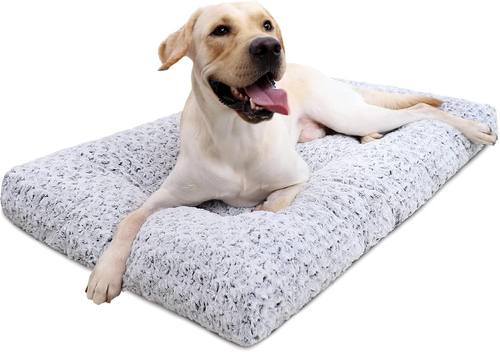
Budget pick: KSIIA Washable Dog Bed Medium Size Dog Crate Bed Plush Pet Mat 35"x23" Gray
 Visit on Amazon →
This is the crate layer I would hand a lab owner before anything else, and it is not because it is a great mattress. It is a mat: 35 by 23 inches, plush, gray, machine washable. Machine washable is the whole point. A lab in a crate is a lab with drool, dirt, and the occasional accident, and a cover you can throw in the wash is worth more than a cover with a fancy name on it.
The honest sizing note: 35 by 23 is a crate mat footprint, not a sprawling lab footprint. It suits Penny at 55 pounds, and it suits a puppy in a properly sized crate. A 75 pound male who sleeps like a starfish is going to hang over the edges, and that is fine if this is the travel and crate bed, not his main floor bed. If it is his only bed, size up and buy something with 3 to 4 pound foam under it.
Flaws but not dealbreakers: Plush is not chew resistant, and it is not pretending to be. A lab under 2 will treat this as a stuffed toy with seams. The pad is thin, so it does nothing for hips on a hard floor. It is a crate mat, and it is honest about that.
Lab owners crate training a puppy, or anyone who needs a washable layer for the car, the vet trip, or the mud season should start here. It also works as a topper on a denser bed for a senior lab who leaks a little.
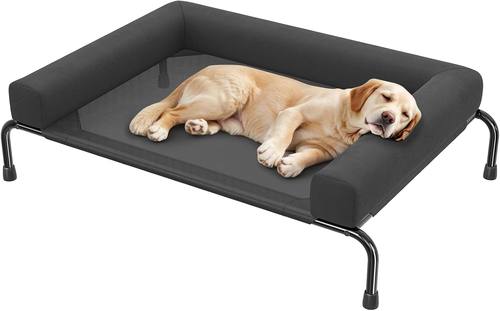
Raised pick: Simple Trending Elevated Dog Bed for Large Dogs with Bolsters, Black
 Visit on Amazon →
Elevated beds are the most underrated pick for a lab household, and here is why. A cot keeps the dog off the floor, which means air moves under him instead of trapping heat, and it means the surface is fabric stretched over a frame instead of foam wrapped in fabric. There is less stuffing to gut, less foam to flatten, and less bed to destroy.
The bolsters matter for a lab specifically. Labs like to lay their head on something, and a raised bed with bolsters at the ends gives him a rail for his chin without turning the whole bed into a pillow he can shred. Black, large, and built for the big-dog class by the name and the spec.
What an elevated bed does not do is support hips. A cot is a comfortable surface, not orthopedic foam. For Penny, that means the cot is her warm-weather bed and her foam bed is still her overnight bed. For Duke, it is the bed he cannot turn into a pile of foam pellets.
Set it up on level ground, not on a slope, and not in the corner where he likes to chew. Put a worn t-shirt on it for a couple of days so it smells like his people. If he is suspicious, scatter three treats on the surface and walk away. Most labs claim a cot within a day.
Flaws but not dealbreakers: A cot gives less joint cushioning than dense foam, so it is the wrong only-bed for a senior lab with hip dysplasia. Some dogs need a week to trust it. And a lab who has never used a raised bed may try to dig at the fabric first, so put it out with supervision until he settles.
Anyone with a young lab, a chewer, a dog who runs hot in summer, or a yard dog who needs a bed that hoses off should look here first.
How to size, place, and set up the bed
Now the part you came for. None of this takes tools, and all of it changes how long the bed lasts.
Step one: measure the dog, not the label. Get your lab flat on the floor in the starfish position, nose to tail. Measure that, then add 12 inches. A 75 pound male usually lands around 40 by 30 inches of sleeping surface. If the bed you are looking at does not publish a surface measurement, assume it is smaller than you hope.
Step two: match the bed to his sleep posture. Labs sprawl. If your dog flops out flat, you need a flat rectangular surface with room to spread. A donut bed is a joke for a lab, because a 75 pound dog does not curl into a ball, he takes up the whole room. Skip anything round and nest-shaped.
Step three: decide the job before you buy. A crate mat and a floor bed are two different purchases. The crate mat is the washable layer that takes the abuse. The floor bed is the thing that supports joints. Buying one bed to do both jobs is how you end up replacing it twice a year.
Step four: set up the crate layer properly. The crate should be one size up from what a chart tells you, so the mat lies flat with no folded edges. Tuck the corners, and check that the mat does not bunch against the door. A lumpy mat is why a lot of puppies cry at night. Wash it every two weeks in cold water and air dry it. Heat is what kills the fabric, and the dryer is heat.
Step five: set up the raised cot for success. Level ground, out of traffic, away from the corner he already chews. Firm footing matters, because a cot that rocks when he jumps on it never gets used. Add a familiar blanket for the first week, then take it away once he is using the cot on his own.
Step six: redirect the chew, do not punish it. A puppy is not chewing to be bad. He is chewing because chewing is what puppies do. Your job is to make the bed boring and the chew toy interesting. When he goes for the bed, swap in a toy and praise the swap. That is the behavior loop, and it works. What does not work is leaving an expensive bed alone with a 5-month-old lab and hoping.
Step seven: give a young lab the cheap layer first. Every lab owner makes the $60 mistake once. If your dog is under 3, buy the washable mat, keep it in the crate, and wait. The good foam bed comes after the shark phase, not during it.
Step eight: adjust the setup for a senior lab. This is where the standards flip. For an older lab, comfort and joint support beat durability every time. Penny's morning limping improved measurably when she moved onto dense foam, and my vet was the one who told me why: labs carry serious weight on those hips, and foam that sinks to the floor does nothing for them. Put the dense bed on the main floor, add the washable mat as a topper for accidents, and keep the cot for the yard.
Step nine: run the pancake test. Fold the bed in half and let go. If it stays folded and does not spring back, the foam is done and no cover is going to save it. Replace the bed, not the cover.
The bed types that lost
Some categories did not make this list, and it is worth knowing why before you spend money.
Donut and nest beds. Built for dogs who curl. A lab sprawls, and a big male in a donut bed sleeps half on the floor with his ribs on the rim. Wrong shape for the breed.
Thin plush pillow beds for young labs. These are the $60 mistake. They feel great in the store, they last about three weeks with a determined chewer, and then you are vacuuming foam out of the carpet for a week. The KSIIA mat survives because it is not pretending to be a mattress and it can go in the wash. A thick plush mattress with a young lab is a stuffed animal with a price tag.
"Indestructible" labels. I have seen the lasted-a-week reviews, and I have lived them. Any product that promises chew-proof without a guarantee behind it is marketing. Buy from people who will replace the cover.
Oversized "large" claims. A large bed that fits a 40 pound dog is not a large bed. Measure the surface, not the marketing.
What this all costs
Two beds is the normal setup for a lab household, and the arithmetic is simple. A cheap bed that dies in four months costs more over three years than a good bed that lasts, and the gap is not close. Add up what you have spent on bedding in the last two years and divide by the number of months you got. That number is your real cost per day.
Cheap math on a washable crate mat: it takes the abuse so the good bed does not have to. Cheap math on a raised cot: it survives a chewer, it dries in an hour, and it does not collect hair the way foam does. Cheap math on the dense foam bed you buy after the shark phase: that is the one your senior lab will actually get joint support from.
Check current Amazon price on both beds above and run the cost per day yourself. It takes two minutes and it will talk you out of the third cheap bed.
The short version
Measure the dog and add 12 inches. Buy the washable crate layer now and the dense foam later, after the chewing slows down. Add a raised cot so there is one surface in the house a lab cannot gut. Wash cold, air dry, and replace the foam the day it stops springing back.
That is the job. Your lab will sleep 14 hours a day for the next decade. Give him something worth sleeping on, and give him something he cannot eat.