Most Labrador puppy sleep setup advice stops at "buy a crate and a blanket." The blanket is the problem. A lab puppy will pee on it, chew it, and drag it through the water bowl, and then you are scrubbing a crate pan at 2 a.m. while the dog watches you like you are the one who made the mess.
I've built this station more times than I want to count, for Duke (75 pounds, black lab, eats anything soft) and for Penny (55 pounds, 11 years old, rescue, hip dysplasia). The version that survives a lab is two layers: a waterproof liner that takes the accidents, and a foam bed dense enough that a 75-pound dog doesn't flatten it into a pancake in six weeks.
Get those two layers right and the station carries a dog from the shark phase through the senior years. Get them wrong and you buy the same bed three times. That's tuition, and you should only have to pay it once.
Why you should trust me
I spent 10 years as a trainer before I started writing about gear, most of it with hunting labs and obedience dogs. The kennels I trained in destroyed equipment faster than any living room ever will, and that's where I learned to stop reading marketing copy and start reading behavior.
I've owned labs for two decades and put more than 40 beds under them. I keep a notebook with foam sink depth, chew timelines measured in weeks, and the date each cover failed. I've cut beds open with a utility knife to check what the foam actually is, because the labels lie and a ruler doesn't. Penny's hip dysplasia is the reason I care about density more than anyone should have to.
I also don't review anything I haven't lived with. If I haven't put a product under my own dogs for at least a month, I say so instead of pretending.
How I picked and how I tested
This guide isn't a "best bed" list. It's the two pieces of equipment that make a crate and sleep station work, and the order you install them in.
Four numbers drive every decision I make here.
Foam density. Measured in pounds per cubic foot. Cheap beds run 1.5 to 2. Dense orthopedic foam runs 3 to 4. A 1.5 foam bed under a lab is a pancake with a cover on it, usually within a season. I check the sink test by hand: press a palm into the foam, count how long the dent takes to rise back.
Footprint. I measure the dog nose to tail and add 12 inches. Labs don't curl up. They sprawl like a starfish, legs in four directions, and a bed sized for a curled dog means elbows on the floor.
Liner function. Absorbency, a waterproof backing, and a non-slip base. If the liner slides, it bunches under the pan and the urine finds the floor anyway.
Wash survival. Covers and liners get washed constantly. Zippers and backing layers die first, and that's what I watch for.
Where a listing doesn't publish the number I want, I say so rather than guess. Density is the one spec that decides whether you're buying a bed or renting one.
The two layers of a Labrador sleep setup
Layer one is protection: something thin, absorbent, and waterproof that sits under the crate, under the pan, or under the water bowl. Layer two is the actual bed, and it needs enough foam to hold a lab's weight without collapsing.
Most people buy layer two and skip layer one. Then they blame the dog for the smell in the carpet.
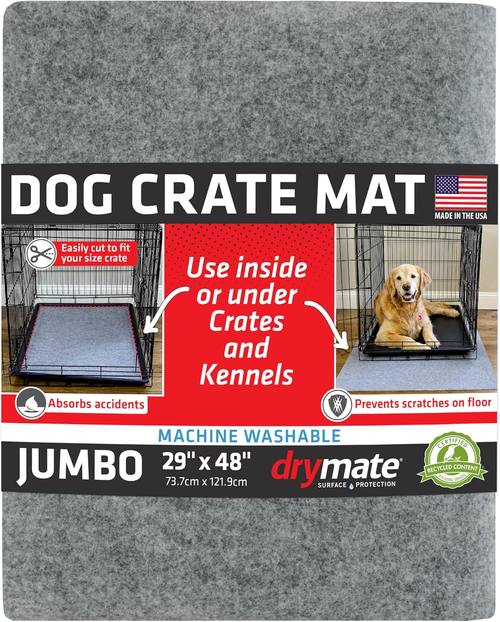
The floor layer: Drymate Dog Crate Mat Liner, Absorbs Urine, Waterproof, Non-Slip, Washable Puppy Pee Pad for Kennel Training - Use Under Pet Cage to Protect Floors, Thin Cut to Fit Design (USA Made) (LGrey)(29"x48")
 Visit on Amazon →
This is the piece people forget, and it's the one that saves your flooring. The listed size is 29 by 48 inches, and the design is thin and cut to fit, which is exactly what you want under a crate pan: you trim it to the footprint so nothing bunches at the corners. It absorbs urine, the backing is waterproof, and the base is non-slip, so it stays where you put it instead of sliding out when the dog shifts weight.
The 48-inch length is useful for more than the crate. I run it under the water bowl and along the front of the pen, because that's where the spills and the accidents actually happen in a lab puppy's first year.
Flaws but not dealbreakers: It's a liner, not a bed. A determined chewer can shred it, so if your pup is a shredder, put it under the pan where teeth can't reach the edges. It's also thin by design, which means it won't cushion anything. That's not its job.
Anyone crate training a puppy, or managing an older lab who leaks a little overnight, needs one of these before they need a nicer bed.
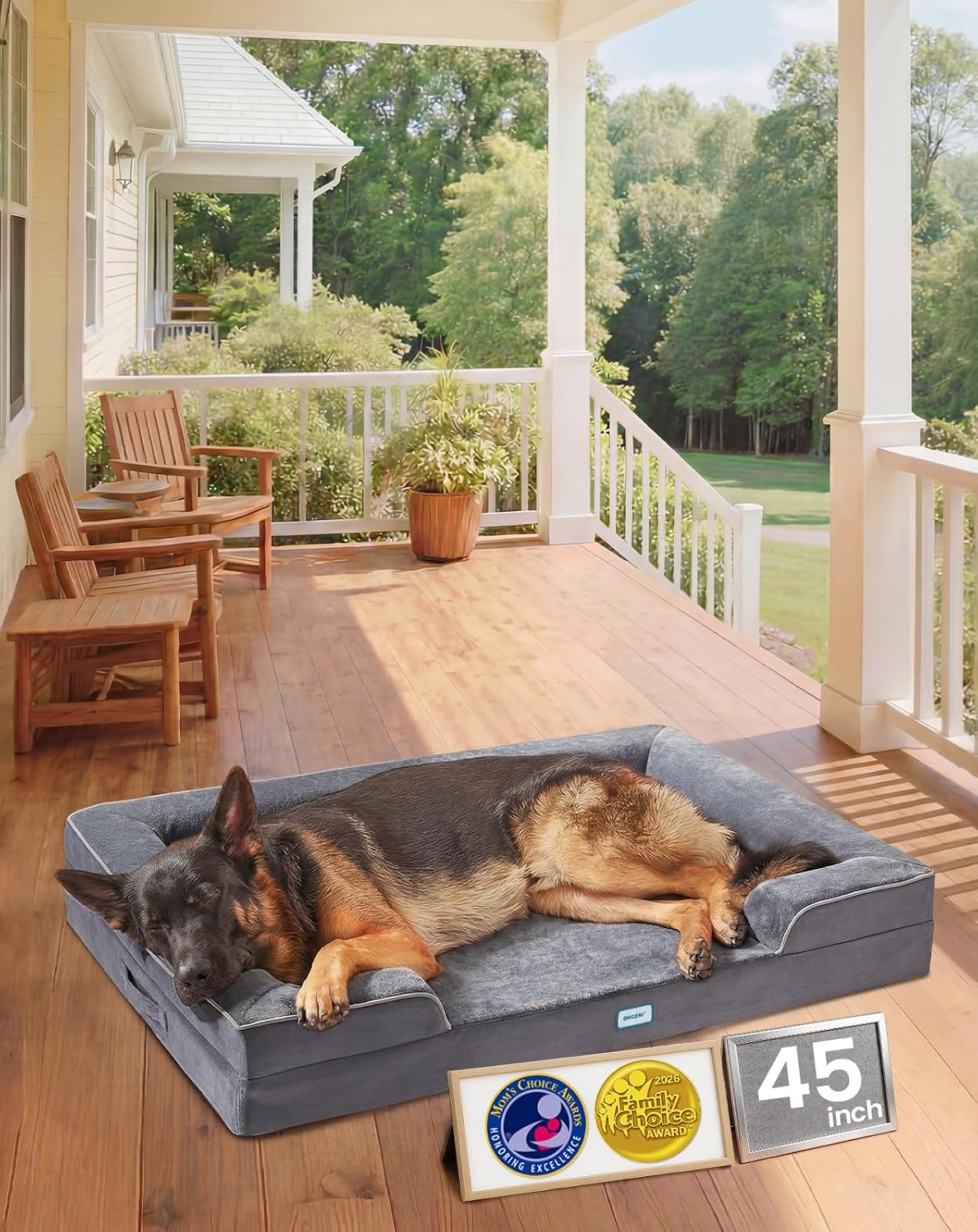
The bed layer: OhGeni Orthopedic Extra Large Dog Bed Couch, Memory Foam, 45-inch (Gray)
 Visit on Amazon →
A 45-inch footprint is an honest extra large for a lab, and that matters because "large" on a pet bed label usually means a 40-pound dog. Forty-five inches gives a sprawled lab room for his front legs without hanging his chest off the edge. The couch shape also gives a lab something to lean his back against, which is how a lot of them sleep when they aren't flat out.
It's memory foam and it's listed as orthopedic, and here's the caveat that decides everything: the listing doesn't publish foam density. Density is the number that separates a bed that supports Penny's hips from a bed that's flat by spring. Ask the seller, or do the palm test when it arrives. If the dent takes more than a few seconds to rise, you have a low-density foam bed, and low-density foam under a lab is a countdown.
Flaws but not dealbreakers: Couch-style bolsters are soft edges, not chew-proof edges. For a puppy in the shark phase, this bed belongs in the pen where you can supervise it, not shut inside a crate with a bored chewer.
Anyone with an adult lab, a senior with stiff mornings, or a dog who sleeps sprawled should be looking at this size class.
How to build the station, step by step
Step one: Measure the dog, not the label. Run a tape from nose to tail and add 12 inches. That's your bed footprint. For most adult labs you land in the 45-inch class, which is why the extra large sizes exist.
Step two: Size the crate honestly. Your lab should be able to stand without ducking his head and turn around without folding. A puppy crate needs a divider so he isn't sleeping in one end and peeing in the other. Cheap crates and expensive crates hold dogs the same way. Spend the money on the bed instead.
Step three: Lay the liner down first. Trim it to the crate footprint, then set the pan on top. If the pan sits on the liner, urine that runs off the pan lands on waterproof backing instead of your floor or your carpet pad. This is the step that saves you a carpet cleaning bill.
Step four: Keep the foam bed out of the crate at first. A puppy in a crate is bored, and a bored lab puppy chews the nearest soft thing. Put the bed in the pen or right beside the crate where you can watch him use it. Once he's past the worst of the chewing, the bed can move in.
Step five: Place it where he can sprawl. Don't tuck the bed into a corner where a wall blocks one side. Labs sleep starfish, and a bed wedged into a corner means one leg on the floor and one shoulder against drywall. Give it open floor on at least two sides.
Step six: Wash the liner weekly and dry it completely. A waterproof backing that stays damp is a smell factory. One wash a week during house training, more if you're in the middle of it.
Step seven: Redirect, don't punish. A puppy isn't chewing to spite you. He's chewing because chewing is what puppies do. Your job is to make the bed boring and the chew toy interesting: frozen stuffed toy, a firm "no" on the bed edge, and the toy swapped in immediately. That's the behavior loop, and it works better than any cover material.
Step eight: Check the foam monthly. Press your palm into the center of the bed. If the dent stays after a slow count of five, the foam is giving up. Note the date. That's how you learn which beds are worth buying again.
Where most lab owners go wrong
Buying plush for a puppy. Plush beds and lab puppies under two years old are a bad pairing. The stuffing ends up across your living room and you spend a week vacuuming foam.
Putting a memory foam bed inside a crate with a chewer. The crate concentrates boredom. Foam plus boredom equals a destroyed bed and, worse, a dog who swallowed foam.
Trusting the word "large." Measure. Every time. A bed labeled large that fits a 40-pound dog is not a lab bed.
Skipping the liner because the crate has a pan. Pans overflow, tip, and get chewed. A liner under the pan is the cheapest insurance in this whole setup.
Buying a donut bed. A 75-pound lab doesn't curl up in a donut. He drapes over it and looks confused.
The competition and why it lost
The plush bolster beds you see in every pet store aisle are built for small dogs who sleep curled. They're soft, they're cheap, and a lab puppy will gut one in an afternoon. That's the $60 mistake, and it's the most common one I hear about.
Donut and cuddle beds fall in the same bucket. They assume a sleeping posture labs don't use.
The heavy ballistic-nylon beds are a different category entirely. They're built for chewers, they hold up, and they are firm. If your lab is under three and eats everything, that's the conversation to have, and it's a different guide than this one. This guide is about the two-layer station: protection underneath, support on top.
Crate pads sold as beds are the last category to skip. A thin pad is a mat, not a bed, and it does nothing for a lab's joints. It has its place under a senior dog who leaks, and the liner covers that job for less.
What this all costs
Check current Amazon price on both pieces before you do this math, then divide what you pay by the months you expect to use it.
The liner is the cheap half and it's the one that pays for itself fastest, because it replaces disposable puppy pads, which are a subscription you never stop paying. One washable liner that survives a year of weekly washes beats a stack of pads every month.
The bed is where the real math lives. A low-density foam bed that pancakes in six months costs more per day than a denser bed that holds its shape for three years. That's arithmetic, not opinion. When you're comparing two beds, don't compare the sticker. Compare price divided by usable days, and be honest about how many usable days a 1.5-density foam is going to give a 75-pound dog.
Set the station up once, in the right order, with the right footprint. Your lab will spend most of his life on it.