
A labrador crate and cool zone is two purchases, not one. They do different jobs and they fail for different reasons. The crate pad gives your lab a defined, cushioned spot inside the kennel, in the truck, and on the living room floor. The raised cot lifts him off the ground so air moves under his belly, which is the difference between a black lab that pants through an Ohio July and one that actually lies down and rests.
I have two labs. Duke is a 75 pound black lab who is 5 years old and chews first. Penny is a 55 pound rescue, 11 years old, with hip dysplasia that shows up as stiff mornings and a slow first walk. They need different things from a bed, and so does yours, which is why I set up crates and cool zones as a two piece system instead of buying one bed and hoping it covers everything.
This is the setup I walk people through. It takes about 20 minutes, one tape measure, and a decision about which piece of gear goes where.
Why you should trust me
I trained dogs for 10 years before I wrote about gear, mostly hunting labs and obedience dogs, and I spent a lot of that time in kennels where the equipment gets destroyed faster than it does in any family home. When I stopped training full time, I kept the habit that matters most: I measure things.
I have put more than 40 beds under Duke and Penny and I keep a notebook on all of it. Foam sink depth, seam failures, zipper deaths, how many weeks a cover lasted before Duke found the weak point. I have cut beds open to look at the foam inside because the label lies and a ruler does not. I have watched a $60 bed turn into a pancake in four months and I have watched a properly built bed hold its shape for years.
A word about what this article is, because it matters. This is a setup guide, not a durability verdict. My rule is that I do not review a bed I have not had under both dogs for at least a month, and these two have not had their month yet. What I can tell you is how to size them, where each one belongs, and what will kill them early, which is the part most people get wrong before the box is even open.
How I picked and how I tested
I did not pick these two because they are the toughest beds on the market. I picked them because they fill the two roles in a lab setup that people most often try to fill with one purchase, and then get frustrated.
Role one is the crate pad. It needs to fit the crate floor, stay put when a 75 pound dog steps on it, and go in a washing machine without falling apart. Role two is the raised cot. It needs to get the dog off hot concrete, off damp grass, and off the floor of a garage, with mesh that lets air through and a frame that does not need a toolbox.
Sizing is where I start with everything. The honest measurement is nose to tail plus 12 inches if the dog is going to sprawl, because labs sleep like starfish, legs everywhere, taking up more room than the number on their vet chart suggests. Then I measure the crate itself, because a crate pad has to match the crate, not the dog's ambition. A mat that is too big bunches up at the door and a mat that is too small slides around and gets chewed at the corner.
The other number I care about is foam. Memory foam and orthopedic foam get measured in pounds per cubic foot. The dense stuff that actually supports a lab's hips runs around 3 to 4 pounds per cubic foot. Cheap foam is 1.5 to 2, and it flattens under a lab in a season. A raised cot does not use foam at all, which is exactly why it is the right call for hot weather and the wrong call for a senior dog's joints.
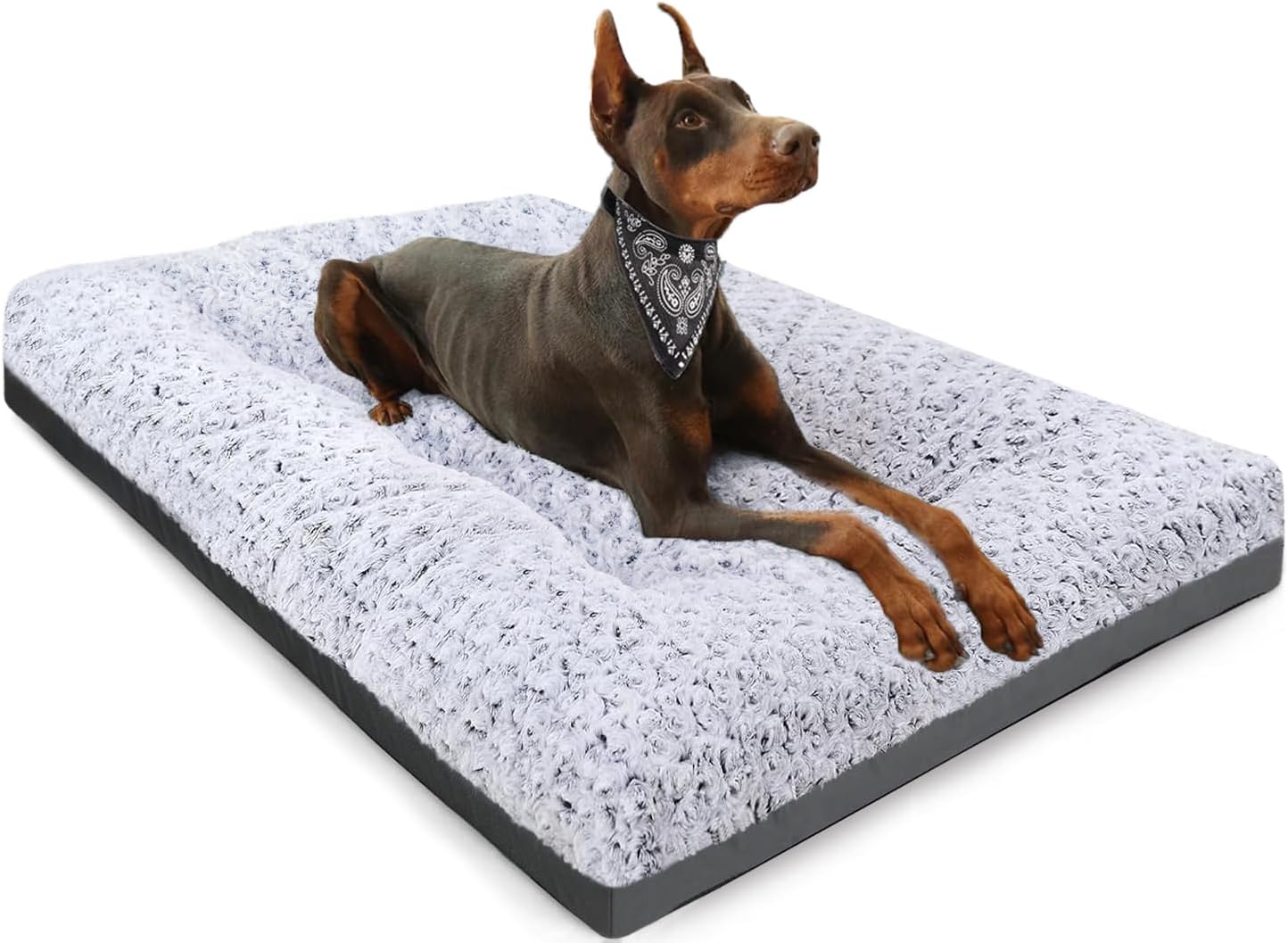
The crate pad: POCBLUE Deluxe Washable Dog Bed for Large Dogs Dog Crate Mat 35 Inch Comfy Fluffy Kennel Pad Anti-Slip for Dogs Up to 60 lbs, 35" x 23", Grey
 Visit on Amazon →
This is the piece of gear that lives in the crate, and if you read the dimensions before you buy, it does its job well. It is 35 by 23 inches, which is a standard intermediate crate footprint, and it is listed for dogs up to 60 pounds. That listing is honest, and I want you to take it seriously. Duke is 75 pounds and sprawls past 35 inches nose to tail when he stretches out, so this is a crate pad for him, not a floor bed. For Penny at 55 pounds, it is a genuine fit.
The surface is plush and fluffy, the backing is anti-slip, and the whole thing is machine washable, which is the feature I care about most in this role. A crate pad sees the worst of it: muddy paws, drool, the occasional accident during a stomach bug, and whatever a lab rolls in outside. A pad you can throw in the wash and air dry beats a fancier pad you are afraid to clean.
Where it earns its place is the shark phase. If your lab is under 3 years old, he is a chewer by definition, and the smart move is a pad that costs little enough that destruction is annoying instead of expensive. This is the kind of pad I tell puppy owners to buy now and replace later with real orthopedic foam once the chewing slows down.
Flaws but not dealbreakers: Plush fabric is not chew-proof fabric. A determined 2 year old lab can open a seam in an afternoon if he is bored and unsupervised in the crate. That is not a defect in the pad, it is a fact about labs. Pair it with a chew toy and a frozen stuffed kong, and check the seams weekly.
Anyone crating a lab up to 60 pounds, running vet trips, or lining a truck bench for a muddy dog will get their money out of this one.
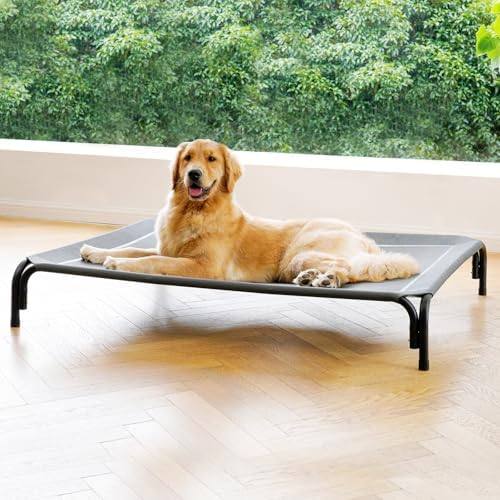
The cool zone cot: Elevated Dog Bed Raised Outdoor Dog Cot for Large Dogs, Installation Requires No Tools, Frame with Washable Cooling Breathable Mesh Anti-Slip Feet, Indoor Pet Bed, Black, 43.3 Inches
 Visit on Amazon →
This is the second half of the system, and it solves a problem no crate pad can solve. A lab lying flat on the ground traps heat under his chest and belly. A raised cot moves air under him, and the breathable mesh does the rest. If you have ever watched a black lab dig at the floor trying to find a cool spot in August, you already understand why this piece exists.
The frame assembles without tools, which sounds like a small thing until you have wrestled an Allen wrench in a garage at 90 degrees. The mesh surface is washable, the feet are anti-slip, and it is 43.3 inches long, which gives a full grown lab room to stretch out instead of curl. It works indoors in a climate controlled room, on a covered porch, and on the deck after a swim, which is where I would use it most.
Where it beats everything else is drying out. A wet lab comes out of the pond or the kiddie pool and a fabric bed stays damp for hours, which is how you get that smell in the house. A mesh cot drains, dries fast, and hoses off.
Flaws but not dealbreakers: There is no foam here, so this is not an orthopedic bed. If your lab is a senior with hip dysplasia, the cot is his summer bed, not his every night bed. He still needs dense foam for the other eight months. The mesh is also not a chew toy. A bored lab left alone with a cot frame will test the corners exactly like he tests everything else.
Anyone with a lab that runs hot, swims, hikes, or spends afternoons outside will use this more than they expect.
The setup workflow
Here is the part you came for. Twenty minutes, one tape measure, no guesswork.
Step one: measure the dog and the crate. Nose to tail on a flat floor, then add 12 inches for sprawl. Then measure the inside of the crate floor, length and width. Write both numbers down. This is the step people skip and it is the step that causes every return.
Step two: match the pad to the crate, not to the dog. A crate pad should fill the crate floor with a little slack at the door so it does not bunch when your lab steps in. If the crate is bigger than the pad, the pad slides and gets chewed at the corner. If the pad is bigger than the crate, it folds and traps dirt in the crease.
Step three: place the cot where air actually moves. Under a tree, on a covered porch, or in front of a fan. A cot in direct sun at 2 pm is a frying pan with legs. Shade plus airflow is the entire point.
Step four: introduce both with a training loop. Do not just drop the gear and walk away. Feed your lab on the cot for a week so it becomes a good place, not a strange place. Toss a treat on the crate pad every time he walks into the kennel. A bed he chooses is a bed he uses. A bed he is shoved onto is a bed he chews.
Step five: rotate by season. Cot for the hot months, pad for the crate year round, and dense orthopedic foam for the cold months if your lab is a senior. Penny gets the cot in July and the foam in January, and her mornings are noticeably better on the foam.
Step six: build a wash routine. Crate pads get washed every two weeks, or immediately after an accident. Cots get hosed and air dried monthly. Zippers and seams die first, so check them every time you wash, and air dry instead of running the dryer on high heat.
Step seven: supervise the first month. Every new bed goes through a probation period with a lab. Watch for corner chewing, seam picking, and the specific look Duke gets right before he decides a bed is a toy.
Where labs break this setup
The most common mistake is buying a plush pad for a puppy and expecting durability. Plush is comfort fabric. Comfort fabric and a 2 year old lab jaw are not a fair fight.
The second mistake is using a cot as an orthopedic bed. Raised cots are for airflow and drying, not joint support. If your lab limps in the morning, a cot alone is not the answer.
The third is leaving a cot out in the rain so the mesh stays wet for days, which is worse than no cot at all. Bring it in or put it under cover.
The fourth is buying one bed for two jobs. One bed in the crate and on the porch means one bed getting destroyed twice as fast.
The competition and why it lost
Donut beds lose here because a 75 pound lab does not curl up. He spreads out like a starfish, and a donut just gives him a wall to push against.
Giant orthopedic foam beds are the right answer for a senior lab's joints, but they are a terrible fit for a puppy or a chewer, and they are heavy to move. That is a winter bed, not a summer one.
Ballistic nylon covers are the other tier, and they survive determined chewers better than anything else I have used, but they cost real money and they are not what you want for a dog still in the shark phase.
None of those replace the two pieces in this guide. They are a different job.
What this costs over two years
I do not quote prices here because they move, so check current Amazon price on both listings and do the math yourself. The math I use is cost per day: price divided by usable days. A pad that lasts two years in a crate costs a fraction of a penny per day, and so does a cot that lives on the porch for three summers.
That is the whole argument. Buy the pad for the crate, buy the cot for the heat, size both honestly, wash both on a schedule, and keep the expensive orthopedic foam for the year your lab turns 8 and his hips start telling you the truth. Duke and Penny do not need a $349 bed to be happy. They need the right bed in the right spot, and a setup that survives them.