Most Labrador crate bed setups fail for one of two reasons. Either the dog eats the bed, or the dog pees on it and the smell moves into the foam and never leaves. Both failures have the same fix, and the fix costs less than the bed you are about to replace.
I have run this setup with two labs. Duke is 75 pounds and treats anything soft as a personal challenge. Penny is 55 pounds, 11 years old, a rescue with hip dysplasia, so her side of the equation is not durability, it is joint support. Same breed, two completely different answers.
The system that works is two layers: a waterproof liner as the base, and a bed with real foam on top of it. Before you buy either one, you measure the dog. That is the whole job. Everything else in the pet aisle is marketing.
Why you should trust me
I spent ten years as a dog trainer before I started writing about gear full time. Hunting labs, obedience dogs, and a few kennels where gear gets destroyed faster than any family living room ever will. I have two labs of my own, and I keep a notebook with chew timelines and foam sink measurements in it, because a bed that "feels supportive" is not data.
I have lived with more than 40 beds at this point. I do not review a bed I have not kept under my own dogs for at least a month, and I will not call anything chew proof until a real chewer has had a shot at it.
One boundary: I am a trainer, not a vet. I will tell you what my vet said about Penny's hips and what foam density does for a senior lab, but I am not diagnosing anything.
How I judge a crate setup for a lab
Four questions, in this order.
Can a determined 75 pound lab destroy it? If yes, it fails. That is the test and it is not negotiable.
Is the dog under three years old? If so, I default to durability and washability over comfort, every single time. Labradors stay in the shark phase longer than most breeds. A puppy is a chewer by definition, and the behavior loop is simple: he chews because chewing is what puppies do. Your job is to make the bed boring and the chew toy interesting.
Does the cover survive the washing machine? Zippers die first. I have killed more covers in the wash than I have on the floor.
Is the size honest? "Large" is a word, not a measurement. Measure your lab from the tip of the nose to the base of the tail, then add 12 inches. That number is your crate length and your minimum bed length.
Foam density matters as much as size. Memory foam is measured in pounds per cubic foot. Cheap beds run 1.5 to 2. Good orthopedic foam for a lab runs 3 to 4. I have cut beds open to check, and the ones that flatten into a pancake within four months are almost always the light stuff.
Cost per day is the only honest comparison. Price divided by usable days. A bed that dies in four months costs more than a bed that lasts three years. That is arithmetic, not opinion.
The two layers you actually need
Layer one protects the floor and the crate pan. Layer two is what the dog actually sleeps on. People skip layer one because it is not fun to buy, then they spend an afternoon scrubbing a crate pan.
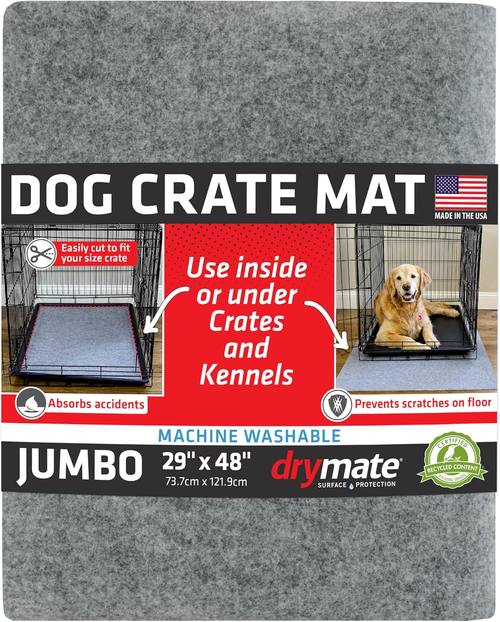
Budget pick: Drymate Dog Crate Mat Liner
 Visit on Amazon →
This is the unglamorous half of the setup and the half that saves you the most grief. It is a thin, waterproof, non-slip mat built to absorb urine, and it is designed to be cut to fit, which matters because no two crate footprints are identical. It is made in the USA in a 29 by 48 inch size, and it is machine washable, which is the feature I care about most. A liner you cannot wash is a liner you throw away.
Where I use it: on the floor under the crate, and inside the crate pan under the bedding. Two placements, two different problems solved. Under the crate it catches the overflow from a puppy who missed. Inside the pan it keeps urine from pooling under the bed and turning into that smell you cannot get out of a car.
It is thin by design. That is the point. It goes under things, not on top of them.
Flaws but not dealbreakers: It is not a chew toy and it is not cushioning. A bored lab can absolutely put teeth into it. It is also not a replacement for taking a puppy out at 2 a.m., it just buys you time and protects your floor while you are learning each other's schedule.
Anyone house training a lab puppy, or living with a senior who has occasional accidents, should own at least two of these so one is always clean.
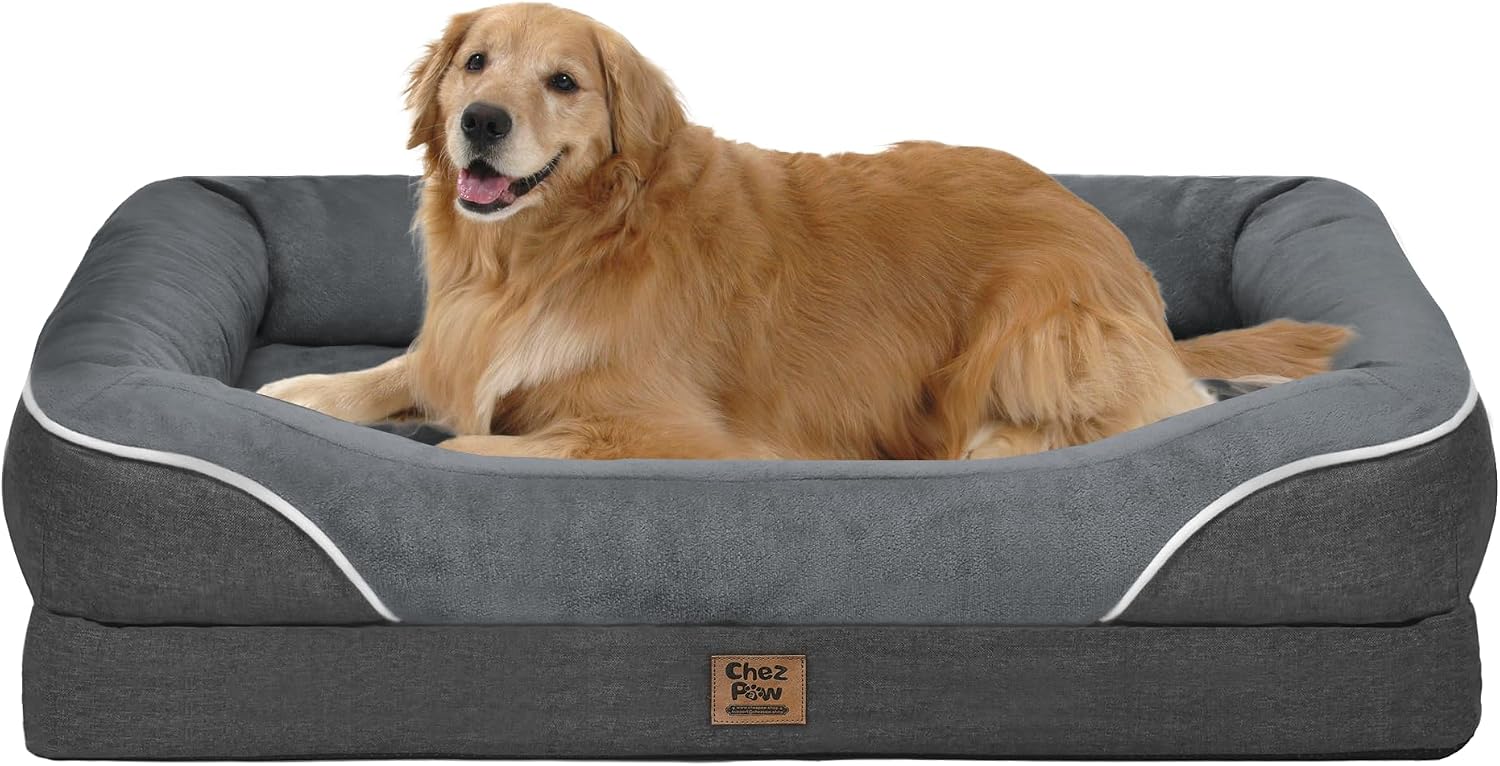
Our pick: Chez Paw Waterproof Orthopedic Dog Bed for Large and Extra Large Dogs
 Visit on Amazon →
This is the comfort layer, and it is built for exactly the size of dog we are talking about: large and extra large breeds. Waterproof plus orthopedic is the right combination for a lab, because those are the two things that actually break a bed. Urine kills foam, and light foam kills hips.
Before you order, check three things on the listing. First, the foam. You want to know the thickness and you want to know whether the density is stated, because a lab carries serious weight and a 1.5 pound foam will pancake under Duke in a season. Second, the cover. Waterproof covers need to come off and go in the machine, or the waterproofing becomes a trap for odor. Third, the size chart against the number you measured, not against the word "large."
Be clear about what this is. It is a support bed for a dog who sprawls like a starfish and needs his joints cradled, and it is the right call for a senior lab like Penny, whose morning stiffness responds to real foam. It is not a chew proof bed. Do not hand it to a two year old lab and walk out of the room.
Flaws but not dealbreakers: Waterproof covers can run warm, so watch how your lab settles in summer. And if your dog is still in the shark phase, this is the wrong purchase today. Buy the liner, wait, and buy the bed when the chewing stops.
Anyone with a lab over three years old, or a senior with hip trouble, should be looking here first.
The setup workflow, step by step
Step one: measure the dog. Nose to tail base, then add 12 inches. Write the number down. This is your crate length and your flat bed length. Do not skip this because you think you know your dog's size. I have watched people buy "large" beds for a 90 pound lab and get a bed that fits a 50 pound dog.
Step two: measure the crate footprint. Length times width of the pan, plus the floor area around it. This tells you how much liner you need and whether you are trimming.
Step three: cut the liner to fit. Set it down, mark it, trim it with household scissors. Cut it a little generous so it can turn up at the edges of the pan, which is what keeps liquid from running off onto the floor. A liner that stops short at the edges is doing half a job.
Step four: build the layers bottom up. Liner on the floor, crate on top of the liner, liner again inside the pan, bedding on top of that. If your dog is a puppy or a senior with accidents, the inside liner is not optional.
Step five: decide which bed goes in the crate. Under three years old, the crate gets a thin washable mat and a chew toy, nothing expensive. Over three, or a senior, the orthopedic bed goes in. This is the single decision that saves lab owners the most money.
Step six: set a wash schedule. Covers and liners get washed on a regular rotation, not when they smell. Cold water, and let foam air dry completely before it goes back in the crate. Heat is what kills foam, not the dog.
Step seven: do the monthly pancake check. Press the foam flat with your palm. If it does not spring back, the bed is done. A pancake is not a bed, it is a mat with a story.
The mistakes that cost you a bed
Buying plush for a puppy. Plush beds for labs under two are a donation. You will be vacuuming foam out of the carpet for a week.
Skipping the liner. This is the $60 mistake, and every lab owner makes it once. The smart ones only make it once. A cheap waterproof liner under a good bed doubles the life of the bed.
Trusting the word "large." Measure. Every time.
Washing on hot and drying on high. You can destroy good foam in one afternoon.
Leaving a chewer alone with an orthopedic bed. No training fixes a two year old lab's jaw. Management does.
What this all costs
The liner is the cheap half of this setup and the bed is the expensive half, and the liner is the one that keeps the expensive half alive. Add the two together, divide by 730 days, and you have a cost per day figure for a two year run. Do that math before you buy, because the cheap bed that fails in four months is the most expensive option on the shelf.
For a puppy, the math is even simpler: liner now, mat now, real bed at three years old. For a senior, it flips. Comfort and joint support beat durability, and the liner is there to protect the foam from accidents.
Short answers to the questions I get most
Do I need a bed inside the crate at all? For a puppy, a thin washable mat is fine and safer. For an adult or senior lab, yes, and it should be flat, because a 75 pound lab does not curl up, he sprawls.
How often should I wash the liner? More often than you think, especially during house training. That is why owning two makes sense.
Can I use the liner on top of the bed? No. The liner goes under things. On top of the bed it just slides around and defeats the non-slip backing.
What if my lab already destroyed one bed? That is tuition. Measure the dog, buy the liner, and decide whether he has earned the good foam yet.
Your lab sleeps 12 to 14 hours a day. That is half his life on whatever you put under him. Build the two layers once, keep them clean, and stop replacing beds every four months.