Most Labrador owners buy a bed, watch it pancake in six weeks, and buy another one. That loop is why I started keeping a notebook. If you are shopping for orthopedic dog beds for labs, the decision comes down to three things: foam density, honest sizing, and a cover that survives the washing machine. Everything else on the label is marketing.
I have two labs in the house. Duke is 75 pounds, five years old, and chews first. Penny is 55 pounds, 11 years old, a rescue with hip dysplasia that shows up as a stiff walk every morning. They need different things from a bed, so every bed gets judged twice here.
This is the how-to, not a list. It is a procedure you can run in about 20 minutes with a tape measure and one careful look at a spec sheet, so you buy once instead of four times.
Why you should trust me
I spent 10 years as a dog trainer before I started writing about gear, most of it with hunting labs and obedience dogs. Kennel floors destroy beds faster than any living room, and I watched which ones came back and which ones went in the trash.
Since then I have put more than 40 beds under Duke and Penny, and I keep a notebook with foam sink depth, chew timelines, and the date each bed failed. Dr. Alvarez, my vet, told me she sees more joint problems in labs than in any other breed she treats. That is why I stopped treating "orthopedic" as a marketing word and started treating it as a spec.
I do not review food, supplements, or anything medical. I am a trainer, not a vet. When I mention Penny's hips, I am telling you what her vet said and what I watched, not prescribing anything for your dog.
How I picked and how I tested
Every bed that comes into this house gets the same routine. A month on the floor minimum. A cover wash in cold water. A look at the foam at the 90 day mark to see whether it bounced back or stayed flat. If a bed cannot survive that, it does not make it into an article.
The criteria I check before anything else:
- Foam density. Memory foam is rated in pounds per cubic foot. Cheap beds run 1.5 to 2. Supportive orthopedic foam runs 3 to 4. I have cut beds open to check, and the difference is obvious with your hand.
- Foam thickness. Two inches of anything is a pancake under a 75 pound lab. Three inches is the floor for a real orthopedic bed, and four is better for a senior.
- Cover construction. Zippers die first. I have killed 14 of them in this house. A removable cover with a heavy zipper and a waterproof liner underneath is worth more than any cooling gel claim.
- Honest sizing. "Large" on a dog bed label means whatever the seller wants it to mean. Measure the interior, not the exterior.
- Chew resistance. If your lab is under three years old, the cover is a chew toy until proven otherwise.
The two beds below are the ones that fit this routine and fit the two labs I actually own: one for the old girl with the bad hips, and one for a household that wants a bed with sides and a cover that comes off.
What "orthopedic" actually means for a Labrador
Here is the short version, because this is where most people waste money.
Orthopedic is not a regulated term. Anybody can print it on a box. The word you want is density.
A lab is a heavy dog that sleeps flat. Duke sleeps like a starfish, legs everywhere, taking up more floor than a queen pillow. A 70 pound lab puts his whole weight on his hips and elbows in that position. Low density foam compresses to nothing under that load and stays compressed. That is the pancake.
Sides help some dogs and not others. A bed with raised sides gives a lab something to lean against and rest his chin on, and it holds a blanket style shape. It does not stop a chewer and it does not add support under the hips. Buy sides for comfort, not for structure.
A waterproof lining matters more than you think. Labs drool, and old labs have accidents. A waterproof liner under a removable cover means you wash the cover, not the whole bed.
A topper is not a bed. A two inch memory foam topper on the floor is a rug with ambition. It will not support a lab's hips.
The two beds I'd put under a lab right now
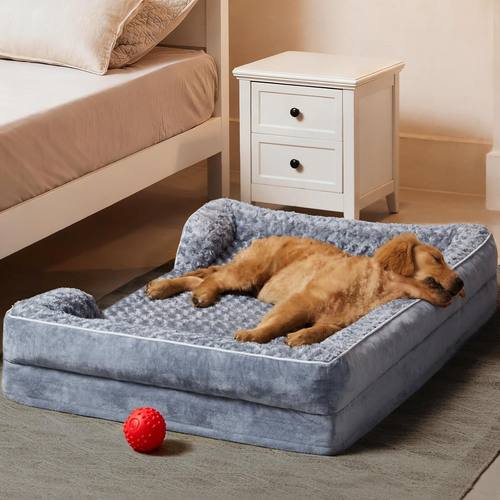
Our pick: WNPETHOME Orthopedic Washable Dog Bed Large for Senior Dog Cozy Sleep
 Visit on Amazon →
This is the one I point senior lab owners to first. It is built as a large bed for a large dog, which sounds obvious until you have measured how many large beds actually fit a 55 pound rescue, let alone a 75 pound male. The washable cover is the feature that keeps it in the rotation here, because a senior dog bed gets washed more often than any other bed in the house.
For Penny, the value is in the support under her hips and elbows. She does not curl up, she sprawls, and a bed that gives her a flat, stable platform with room to stretch is the difference between getting up easily in the morning and needing a hand. If your lab is over eight, or if your vet has used the word dysplasia or arthritis in the same sentence as your dog's name, this is the shape of bed to look at.
Flaws but not dealbreakers: A large bed takes up floor space, and there is no way around that. Measure your spot before you order. If you have a smaller lab or a tight corner, size down rather than squeeze this into a gap.
Anyone with a senior lab, a big male, or a dog who has had a hard stretch on the joints should start here.
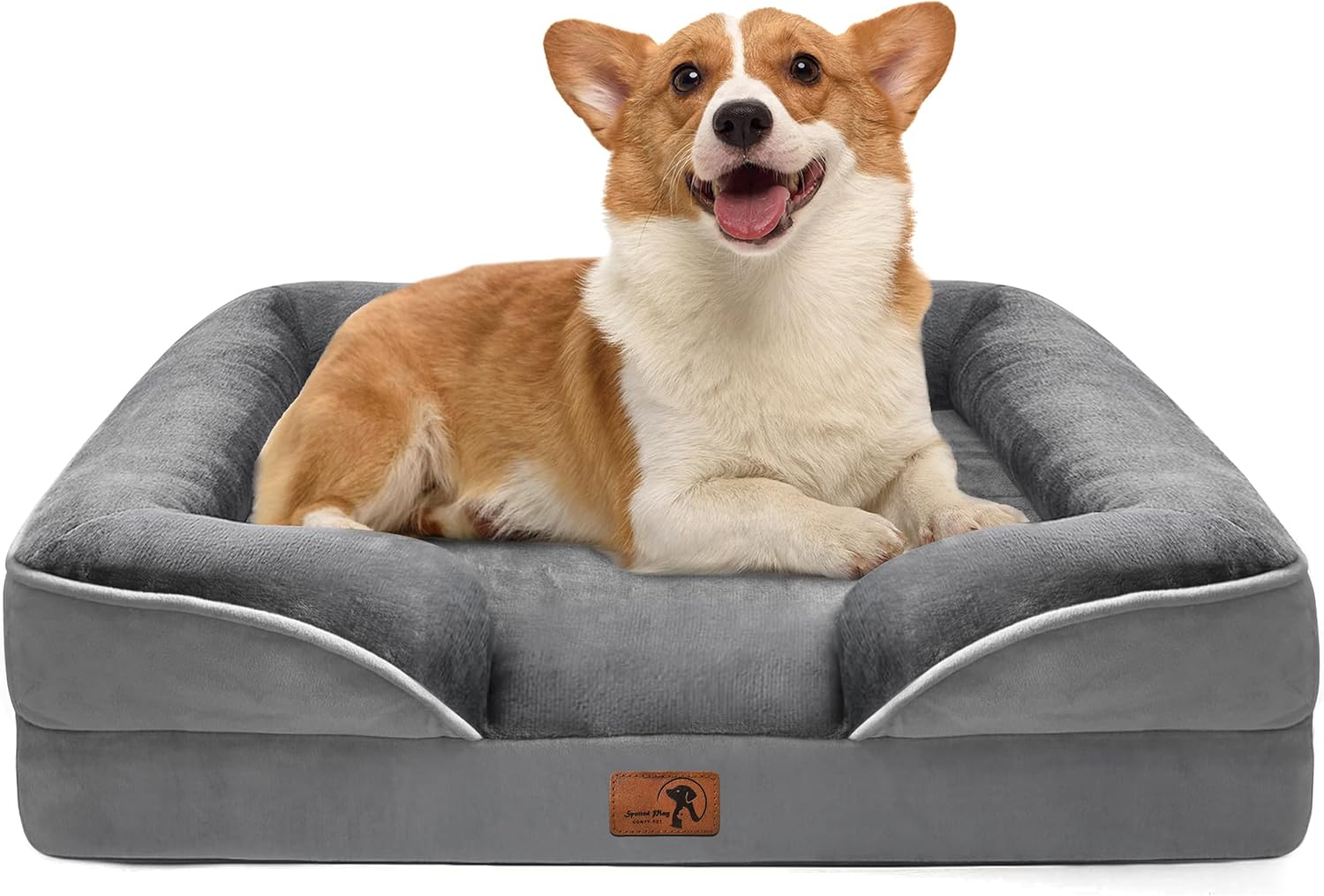
Runner-up: Spotted Play Orthopedic Dog Bed with Sides - Dog Sofa Beds for Medium Dogs, Supportive Foam Pet Couch Bed with Washable Removable Cover, Waterproof Lining and Non-Slip Bottom, Grey - M
 Visit on Amazon →
This is the sofa style bed, and it solves a specific problem: the lab who wants to lean. The raised sides give him a bolster for his chin and his shoulder, and the non-slip bottom keeps the whole thing from sliding across hardwood every time he launches off it. For a 55 pound lab, the medium size is honest sizing rather than wishful thinking.
The waterproof lining is the detail I care about most. It sits under the removable cover, so drool, water bowl drips, and the occasional senior accident stop at the cover instead of soaking into the foam. Pull the cover, wash it cold, air dry it, and the bed is back in service the same day.
Flaws but not dealbreakers: The raised sides are a comfort feature, not armor. If your lab is in the shark phase and eats fabric, no sofa bed survives that, and this one is no exception. Wait until your dog is past three, or keep this bed where you can watch him.
Anyone with a medium lab, a young adult dog past the chewing stage, or a dog who likes to sleep against something will get the most out of this one.
Measure before you order: the five minute routine
This is the part people skip, and it is the part that causes returns.
Step one: measure your dog nose to tail. Not his weight, his length. A sleeping lab needs room to stretch out flat, so add 12 inches to that number. That is your minimum interior length.
Step two: measure the interior of the bed, not the exterior. Sellers quote the outside footprint because it sounds bigger. If the listing only gives exterior dimensions, subtract several inches for the bolsters and the frame. A large bed with a fat bolster can have a medium sleeping surface.
Step three: watch how your dog actually sleeps for one night. Starfish means you need maximum flat surface. Curled against a wall means sides and a corner will get used. Penny sprawls, Duke sprawls and then rolls, and neither of them has ever used a donut bed for more than a nap.
Step four: measure your floor space and your doorways. A big bed that blocks the hallway gets shoved into a corner where nobody uses it. Measure the spot, and measure the door the bed has to come through.
Step five: check the cover before you buy. Removable, machine washable, waterproof liner underneath. If the cover does not come off, the foam is going to smell like wet dog within a year and there is nothing you can do about it.
Setting the bed up so it lasts
Give it a place, not a spot in the traffic lane. A bed in the middle of the room is a launch pad. A bed in a corner, against a wall or a couch, gets slept in.
Wash the cover before the first use. Covers ship with manufacturing residue and a smell your lab will investigate with his teeth. One cold wash and an air dry removes most of it.
Never put the foam in the dryer. Heat kills foam. Air dry the cover, and spot clean the foam with a damp cloth if it gets soiled.
Check the foam at 90 days. Press your palm into the middle of the bed. If you can feel the floor through it, the bed is done for a heavy lab, no matter what the label promised. Rotate the bed end to end at the same time so the wear is even.
Redirect, do not punish. If your lab chews the bed, he is not being bad, he is being a lab. Make the bed boring and the chew toy interesting, and put the bed up when you cannot supervise. Training fixes the habit. Nothing fixes a two year old lab's jaw.
The competition and why it lost
Donut beds are the first thing to cross off the list for a lab. A 75 pound lab does not curl into a ball, he sprawls, and a donut gives him a rim to fight with instead of a surface to sleep on.
Plush beds with loose stuffing are the second. Under two years old, a lab will open one up and you will be vacuuming foam for a week. I have lived that. The $60 mistake is tuition, and most people pay it once.
Crib mattresses and memory foam toppers show up in every budget thread. A topper is not a bed. It has no cover, no liner, and no structure, and it flattens under a lab's hips in a season.
At the other end, the Big Barker and K9 Ballistics both earn their reputation with heavy dogs. The Big Barker is the bed I recommend when a senior lab needs serious support and the budget is not the first concern. K9 Ballistics is where I send owners of dogs who destroy everything, because the covers are built for it and the warranty has paid out in my experience. Neither one is in this article, because neither one is the bed I would hand a first time lab owner who wants a washable cover and an honest size for a medium or senior dog.
Orvis covers deserve a mention for one reason: the zippers. Twenty plus washes and they still close. The foam is average, but a good cover on average foam beats a bad cover on good foam, because the cover is the part that fails first.
What this all costs
Stop thinking about the sticker and think about cost per day. Divide what you pay by the number of days the bed actually works.
A cheap bed that dies in four months costs more per day than a bed that lasts three years, and that is arithmetic, not opinion. For most lab owners the sweet spot for a bed that survives a few years lands somewhere in the middle of the market. Below the bargain tier, you are usually renting a bed for a few months.
Both beds in this article sit at the value end of that math, which makes either one easy to justify as a first orthopedic bed, a bed for the crate, or a second bed for the room your lab actually sleeps in. Check current Amazon price on each listing before you decide, because prices move and the cost per day math only works with today's number.
The other cost nobody counts is the cover. A washable cover that survives 20 washes saves you from replacing the whole bed. That is the entire argument for removable covers in one sentence.
The bottom line
Measure your dog, check the foam thickness, confirm the cover comes off, and buy for the size your lab actually is, not the size you wish he was. If he is under three years old, buy cheap and expect to lose it. If he is a senior with hips that talk to him in the morning, spend the money on support and give him a flat place to sprawl.
That is the job. Your lab will spend more hours on this bed than on any piece of furniture you own. Buy it like it matters.