
Most people start crate training with a towel and a prayer. The puppy pees on the towel, drags it into a corner, chews a hole in the middle of it, and you spend the next morning on your hands and knees trying to pull urine smell out of a floor that already drank it. I have done that twice, once with Duke and once with a foster lab whose name I have blocked out on purpose.
A labrador crate and bed setup done right takes about 20 minutes and two pieces of gear. Do it before the dog comes home and you skip the floor repair, the pancake foam, and the 2 a.m. laundry.
I am Mike. I spent 10 years as a dog trainer, mostly hunting labs and obedience dogs, and now I write about gear full time from Ohio. I live with Duke, a 75 pound black lab who is five and has never met a zipper he respected, and Penny, a 55 pound rescue who is 11 and came to me with hip dysplasia. Between the two of them I have put more than 40 beds through the wringer. I keep a notebook. The notebook is the only reason anyone should read what I write.
Why you should trust me
Ten years of training labs taught me one thing about beds: the label is fiction and the dog is the test. I have watched a kennel full of working labs destroy gear that came with a warranty longer than the dog's life expectancy. I have also watched a cheap flat bed outlast an expensive one, because the expensive one had cover seams that were easy to grab.
I do not trust the word "indestructible." I trust a chew timeline, which is how many weeks a material survives a determined lab. I write those numbers down. I also cut beds open with a utility knife when a cover fails, because the foam inside tells you more than the marketing copy outside ever will.
Where I draw the line: I am a trainer, not a vet. I will tell you what my vet said about Penny's hips, but I will not diagnose your dog. And I will not recommend a bed I have not put under a lab for at least a month.
How I picked and how I tested
The two products in this guide do not compete with each other. One is a floor protector for the crate phase. The other is a sleep surface for a lab that is done chewing. You need them at different points, and buying them in the wrong order is how people end up replacing a bad bed every four months.
Here is the standard I apply to anything that goes under a lab:
- Size honesty. "Large" is a marketing word. I measure nose to tail and add 12 inches. A 75 pound lab sprawled out like a starfish needs every inch of that, and he will not curl up to fit your floor plan.
- Foam density. Memory foam is measured in pounds per cubic foot. Under 3 pounds and a lab's weight turns it into a pancake in a season. Budget beds often run 1.5 to 2.
- Wash survivability. Covers get washed, and zippers die first. I have retired more of them than I want to count.
- Chew timeline. Every material gets judged in weeks against Duke, not in years against a brochure.
I apply the same filters to liners: does it actually hold liquid, does it stay put on a hard floor, does it survive the washing machine, and can I cut it to fit a crate that is not a standard size.
The two pieces you need before the dog comes home
Buy them in this order. The liner goes down first, because the puppy phase is a liquid phase, and the bed comes later, once the dog has stopped treating fabric as food.
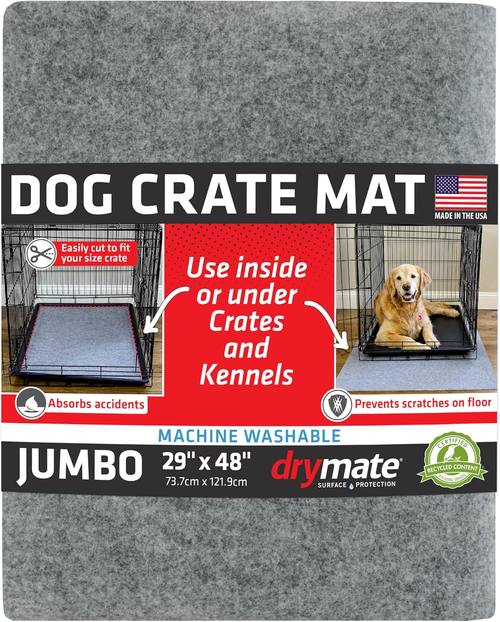
The floor saver: Drymate Dog Crate Mat Liner, Absorbs Urine, Waterproof, Non-Slip, Washable Puppy Pee Pad for Kennel Training - Use Under Pet Cage to Protect Floors, Thin Cut to Fit Design (USA Made) (LGrey)(29"x48")
 Visit on Amazon →
This is the piece I tell every lab puppy owner to buy before the crate arrives. It is a thin waterproof mat that goes under the crate, not inside it, so the accidents that run out of the crate door land on the mat instead of your floor. The backing is non-slip, which matters more than people think. A mat that slides around while a puppy is spinning in a crate is a mat that ends up bunched in a corner doing nothing.
The cut to fit design is the part I actually care about. Crates come in odd sizes, and a mat that hangs over the edge just wicks liquid onto the floor anyway. Trim it to the footprint and you are done.
It is machine washable, made in the USA, and thin enough that the crate door still swings over it without lifting. For kennel training, a puppy, or a senior lab who leaks a little overnight, this is cheap insurance. I have watched a senior lab's accidents ruin a rug. This prevents that for less than a bag of dog food.
Flaws but not dealbreakers: It is a liner, not a bed. Leave a puppy on this with nothing else and he is sleeping on a waterproof sheet. That is the point during the chewing phase, but do not mistake it for comfort.
Anyone with a puppy, a senior lab, or a crate sitting on hardwood should have one of these under the crate before the dog comes home.
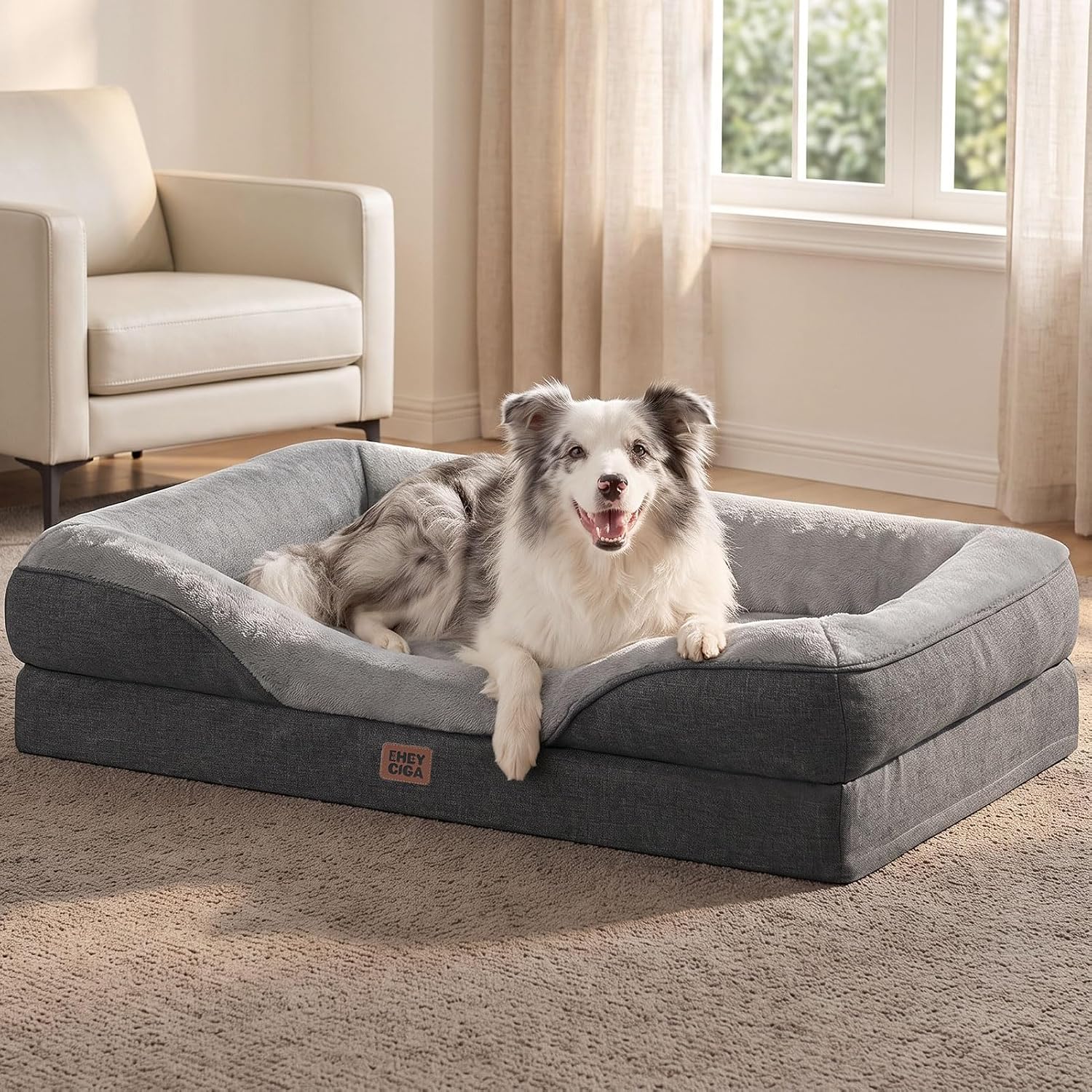
The sleep surface: EHEYCIGA Orthopedic XL Dog Bed for Large Dog, Memory Foam Dog Couch, Grey
 Visit on Amazon →
This is the bed that shows up once your lab is out of the chewing window, or once he is old enough that his hips need support. It is an XL orthopedic couch style bed with memory foam and a grey cover, sized for a large dog, which means a lab can stretch out flat instead of folding himself into a shape he was never built for.
The couch shape is the detail I like. A lab sleeps sprawled with his legs out, and the bolsters on a couch bed give him something to rest his chin on without cutting his usable space in half the way a full donut bed does. For a senior lab with hip dysplasia, that headrest matters. It takes weight off the neck and shoulders when he lies down.
The memory foam is the reason to pick this over a plush bed. Plush beds photograph well and flatten into a pancake the first month a 75 pound lab sleeps on them. Orthopedic foam is built to hold shape under weight, and for a dog carrying lab weight on lab hips, that is the difference between a bed and a floor mat with delusions.
Flaws but not dealbreakers: Memory foam beds and determined chewers do not mix. If your lab is under three and still in the chewing phase, this bed is a chew toy with a price tag. Wait.
Anyone with an adult lab, a senior lab, or a big dog who sleeps like a starfish will get real use out of this one.
The actual setup workflow
Now the part you came for. This is the order I set up a crate and sleep station, and it works for a puppy or a senior.
Step one: Measure the dog, not the label. Nose to tail, then add 12 inches. Duke runs 34 inches nose to tail, so he needs a bed at least 46 inches long, and that is why XL is not optional for him. Do this before you buy anything. A "large" bed that fits a 40 pound dog is the most common sizing lie in this category.
Step two: Buy the crate for the adult dog. Puppies grow into crates, not the other way around. Buy a crate sized for the 8 week old and you will buy a second crate in six months. Buy the size your lab will be at two years, block off the extra space with a divider while he is small, and skip the second purchase.
Step three: Put the liner under the crate, not inside it. Lay the mat on the floor, set the crate on top, and trim the mat so it does not stick out past the crate footprint. Inside the crate during the first weeks, keep the surface boring. No plush bed, no blanket he can shred and swallow. A chew toy and a towel are enough. The mat catches what runs out the door.
Step four: Expect accidents and plan for them. A puppy will pee in the crate. That is not failure, that is a puppy. The liner's job is to keep that liquid off your floor while you clean the crate. Pull the crate out, hose it down, wipe the mat, put it back. Five minutes.
Step five: Know when the liner phase ends. For a lab, the chewing window runs to about three years. Until then, your money goes into durability and floor protection, not comfort. Once your lab is past that phase, or once he is a senior who needs joint support, the orthopedic bed comes in.
Step six: Put the bed where the dog already sleeps. Do not pick the spot for him. Watch where he sprawls for a week, then put the bed there. A bed in the wrong corner is a bed nobody uses, and it will get chewed out of boredom. If he sleeps in the living room in front of the couch, that is where the bed goes.
Step seven: Wash on a schedule. Liner once a week, bed cover once a month, more often if your lab is a swimmer or a drooler. Zippers are the first thing to fail, so close the cover before it goes in the machine and wash cold. Heat kills foam and shrinks covers.
Step eight: Inspect the seams monthly. Run your hands along every seam and the zipper line. A lab works on a weak point for weeks before it fails. Catching a seam before it opens is the difference between a repair and a replacement.
What I would skip instead
The plush donut bed. Labs do not curl up. A 75 pound lab sleeps like a starfish, and a donut bed wastes half its footprint on walls he will push flat. Buy the couch shape instead.
The bed with "indestructible" in the listing title. That word has never survived a two year old lab in my house. If a brand leads with that claim and will not back it with a replacement policy, keep scrolling.
The cheapest memory foam bed at the bottom of the search results. Foam under 3 pounds per cubic foot flattens in a season, and then you are buying again. That is the cheap bed mistake, and it is tuition. You pay it once if you are smart.
The oversized "large" bed that actually fits a 40 pound dog. Measure your dog. Add 12 inches. Ignore the label.
And skip the idea that a puppy needs a nice bed. He does not. He needs a crate, a liner under it, and something to chew that is not upholstery. The nice bed is for the dog he becomes.
What this all costs
Two purchases, one setup. The liner is the cheapest part of the whole thing and the one that saves the most money, because floor repair costs more than any bed on this page. The orthopedic bed is the bigger spend, and it is the one that should last.
Do the arithmetic honestly. Take what you pay for the bed, add the liner, and divide by 730 days. That is two years, which is the minimum I expect a bed to survive a lab. If the number lands well under a quarter a day, you bought right. If you are replacing a pancake every four months, the number is worse and you feel it every time you haul a soggy cover to the laundry.
That is the whole setup. Measure the dog, line the crate, keep the crate boring until the chewing stops, then put real foam under him when his hips start asking for it. Twenty minutes and two pieces of gear, and you skip the mistake most lab owners make twice.