Labradors are heavy sleepers in every sense. A 70 to 80 pound lab does not curl into a tidy ball, he stretches out flat, legs in four directions, and drops his full weight onto whatever foam is underneath him. That is why shopping for orthopedic dog beds for labradors comes down to geometry, foam, and laundry more than style. The bed has to be long enough for a starfished dog, dense enough to keep hips off a hard floor, and tough enough to survive a lab who treats zippers as a snack.
Most people start the way the listings want them to. They search for a "large" dog bed, sort by price, and pick whatever looks softest. Then the bed arrives, a 75 pound lab climbs on, and within a few months the foam is a pancake. The label said large. The bed fits a 40 pound dog. The fabric looked plush, and the plush ended up as stuffing spread across the living room floor.
This guide walks through four affordable beds that suit different lab situations, from a young chewer to a senior with stiff hips, and explains the checks that matter before you spend anything.
Related: How to Measure Your Labrador for a Dog Bed →
Quick answer
Match the bed to your dog's sleep style and age, not to the word "large" on the listing. A lab that sprawls needs a flat sleeping surface long enough for his nose-to-tail length plus roughly 12 inches of margin, which for a big male usually means something longer than the beds most retailers call large. A lab that curls toward the center can use a donut style, though a 30 inch donut is a medium bed and will not hold a full grown male. Three features are worth paying for: foam that holds its shape, a cover that comes off and goes into the washing machine, and a base that does not slide across hardwood. None of these four beds is chew proof, and none of them should be treated as indestructible.
Four useful options
| Model | Best fit | What stands out |
|---|---|---|
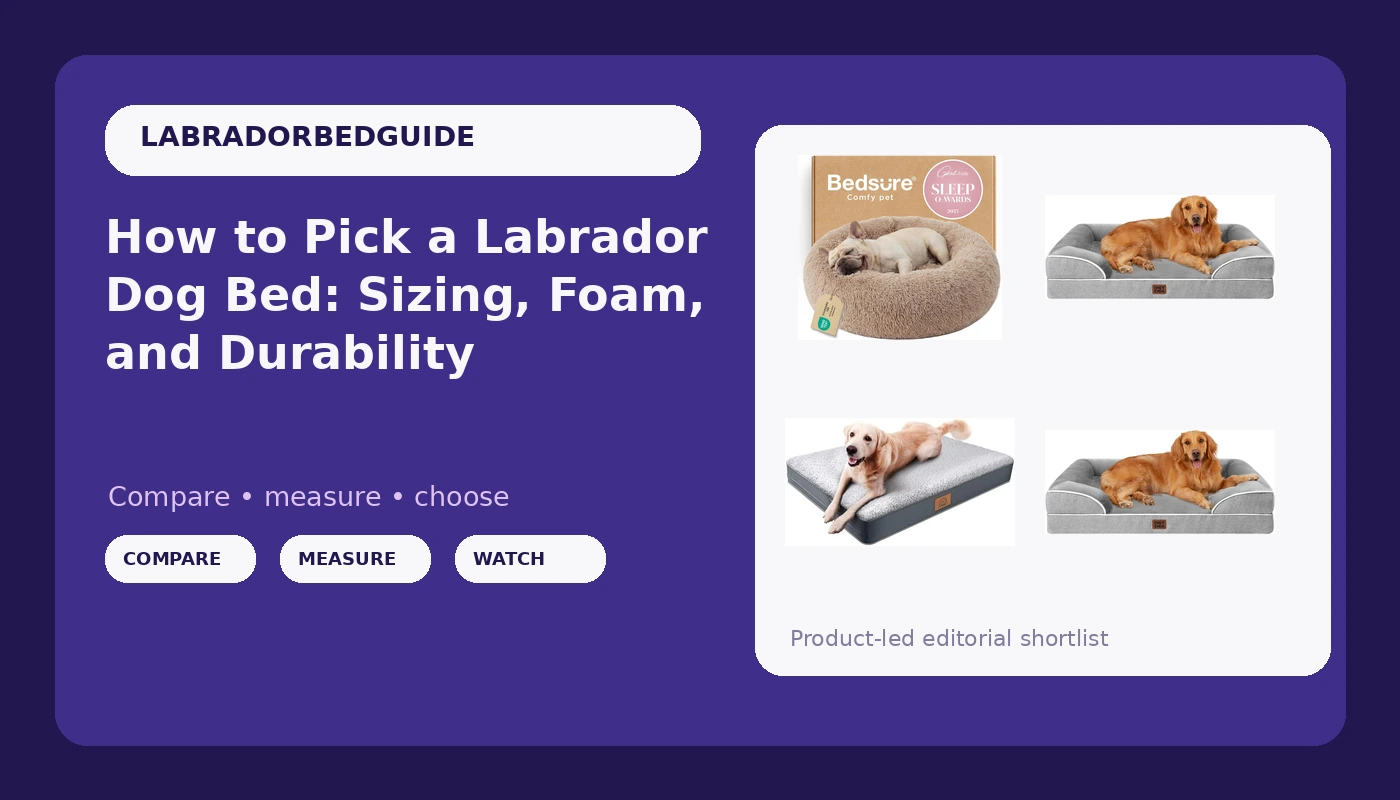
| Bedsure Calming Dog Bed Medium Size Dog Donut | Smaller labs and confirmed curlers | Round donut shape with a raised rim, washable, 30 inch footprint |
| EHEYCIGA Orthopedic Dog Bed Large Sized Dog with Sides | Sprawlers who like a headrest | Waterproof memory foam, raised sides, non-slip bottom, removable washable cover |
| Sunheir Washable Orthopedic Large Dog Bed | Seniors and dogs who avoid bolsters | Flat mat profile, orthopedic foam, removable washable cover |
| EHEYCIGA Orthopedic Dog Bed for Large Dogs with Egg-Crate Foam | Labs that lean and settle into a couch shape | Egg-crate foam over waterproof memory foam, sides, non-slip bottom, removable cover |
The calming donut: Bedsure Calming Dog Bed
The donut is the style most lab owners outgrow, and the reason is simple arithmetic. Thirty inches is a medium bed. A 55 pound lab who still tucks into a ball can use it. A 75 pound lab who sleeps like a starfish will hang off both sides and end up on the floor by morning. There is also a durability question: a raised, stuffed rim is the first thing a young lab grabs and shakes. This bed makes the most sense as a secondary bed for a smaller lab, a senior who circles before settling, or a corner of the house where you want something easy to wash.
The budget orthopedic with sides: EHEYCIGA Large Sized Dog Bed
This is the sensible first orthopedic bed for a lot of lab households. The sides give a headrest, the waterproof layer matters for an older lab with occasional accidents or a dog who comes in wet from the yard, and the removable cover is the feature that keeps a bed in service instead of in the trash. The trade-off is that memory foam at this price point is generally not the dense slab used in premium orthopedic beds, so a heavy lab may compress it over time. Plan on rotating the foam and watching for flattening in the spots where he puts the most weight.
The low-profile orthopedic mat: Sunheir Orthopedic Large Dog Bed
For a senior lab with hip dysplasia, the value of a flat mat is that there is no rim to lift a leg over. A dog who is stiff in the morning often stops using a tall sided bed simply because getting in and out hurts. This mat also works as a topper on top of an existing bed or on carpet in a room where you want a low profile option. The honest downsides are thin insulation from a cold floor and less of a "settle in" feel, plus the fact that a mat gives a determined chewer exactly one target: the cover.
The egg-crate couch: EHEYCIGA Orthopedic Dog Bed for Large Dogs
Egg-crate foam, the convoluted kind with peaks and valleys, is the same material used in human mattress toppers for pressure relief. It lets air move under a dog and it spreads weight across more surface, which is why it shows up in beds aimed at older or heavier dogs. What it does not do is provide the firm structural support of a dense solid slab. If your lab likes to press against a side and sleep in a half upright position, this couch shape suits him well, and the washable cover helps with the shedding a lab produces year round.
Prices and availability may change. Product images, names, and retailer links are matched to verified listings. No current price, rating, stock status, or measured result is stated here without current evidence.
Why "large" means something different at every retailer
Bed dimensions on a listing are usually outside dimensions, and on a sided bed a chunk of that measurement is the bolster itself. A bed listed at 40 inches might give a dog 32 or 34 inches of usable interior space. That is the gap where lab owners get burned. A big male lab measured from the tip of his nose to the base of his tail commonly lands in the mid 30 inch range. Add the margin a flat sleeping dog needs, and you are looking for something considerably longer than the beds most retailers label large.
The fix is to measure your own dog instead of trusting a size word. Have him lie down stretched out, measure nose to tail base, then add about 12 inches for a flat bed. For a bed with bolsters, you can subtract some of that margin if your lab curls against the rim, but not if he sprawls. Then compare your number to the interior measurement, not the outer footprint, and read the size chart rather than the product title.
What foam density and egg-crate construction actually mean
Memory foam is graded in pounds per cubic foot. Very inexpensive beds often use foam in the 1.5 to 2 pound range, which compresses and stays compressed under a heavy dog. Better orthopedic beds use denser foam in the 3 to 4 pound range that recovers its shape. Density is not always published, so look for it in the listing details, and treat vague words like "premium" or "plush" as marketing rather than specification.
Construction matters as much as the number. Egg-crate foam is softer and more breathable, good for pressure distribution, weaker at holding a dog up off the floor. A solid slab is firmer and heavier. A waterproof liner is the difference between a foam core that lasts and one that smells, because a removable cover only helps if the foam inside is protected from accidents, drool, and wet fur.
One more part fails before the foam does: the zipper. Wash the cover on a gentle cycle with the zipper closed, and let it air dry. Heat and tumbling are what kill the seams and the zip.
- Measure your lab nose to tail base while he lies stretched out, then add about 12 inches for a flat bed.
- Match shape to sleep style: flat for sprawlers, donut or sided for confirmed curlers.
- Check the foam description for density or at least a waterproof liner, and skip anything described only as soft.
- Confirm the cover is removable and washable, and that the bottom has a non-slip surface for hard floors.
- Set your budget by the dog's age, spending little on a puppy and more on a lab over seven or one with hip issues.
Practical guidance for lab owners
- Treat the first two years as a chewing phase and buy a bed you can afford to replace, no matter what the listing promises.
- Put the bed on a rug or add a non-slip pad underneath if your floors are smooth; a sliding bed is an unstable bed.
- Rotate or flip the foam every month or so to slow compression where your lab puts his weight.
- Keep a legal chew toy near the bed so the cover and zipper stay boring.
- For a stiff senior, favor a flat or low entry bed over a tall sided one, since stepping in can be the hard part.
- Wash the cover before the first use and after every muddy season, and air dry it rather than tumbling it.
Which option should you choose?
Choose the Bedsure Calming Dog Bed when your lab curls, weighs under about 55 pounds, or you want a washable secondary bed for a crate corner. Choose the EHEYCIGA Orthopedic Dog Bed Large Sized Dog with Sides when you want a sided orthopedic bed with a waterproof core and a non-slip base at the lowest entry point of this group. Choose the Sunheir Washable Orthopedic Large Dog Bed when your lab is a senior, is recovering from an injury, or simply refuses to use anything with a rim. Choose the EHEYCIGA Orthopedic Dog Bed for Large Dogs with Egg-Crate Foam when you want convoluted foam and a couch shape for a lab who leans into a side.
A caveat worth stating plainly: listings get revised, sizes get renamed, and foam specifications are not always published, so verify the interior measurements and materials on the current listing before you buy. And if your lab is a determined chewer, no bed in this group replaces supervision, a crate, and something legal to destroy.
The bottom line
For most lab households, the decision comes down to shape first and foam second. Measure your dog, decide whether he sprawls or curls, and then pick the construction that fits. The sided orthopedic beds give you a waterproof core and a washable cover, the flat mat trades height for easier access, and the donut only works if your lab is genuinely a curler or smaller than the breed average. Buy for the dog you have now, expect to replace a cheap bed sooner than an expensive one, and keep your expectations about chew resistance realistic.