Choosing an orthopedic dog bed for a Labrador comes down to three things: honest size, dense foam, and a cover that survives the washing machine. Everything else on the product page is decoration.
I have two labs on the floor of my house right now. Duke is 75 pounds of black lab who sleeps like a starfish, legs pointed in four directions, and he chews anything with a seam. Penny is a 55 pound rescue with hip dysplasia who sleeps curled on her side and limps in the morning until she gets moving. They need different things from a bed, and neither of them needs a plush donut that turns into a pancake in four months.
So here is the process I use when a lab owner asks me what to buy. Measure first, check the foam spec second, worry about the cover third, and only then look at price. The two beds below are the ones I point lab owners toward when the measurements say XL and the dog is past the chewing stage.
Why you should trust me
I spent 10 years as a trainer working with hunting labs and obedience dogs before I started writing about gear full time. Kennel owners destroy equipment faster than any family home, and I watched what survived there. I keep a notebook with foam sink depths, chew timelines, and dates of failure, and I have cut open cheap beds to see what the "memory foam" actually was.
I am not a vet and I will not pretend to be one. What I can tell you is what my vet, Dr. Alvarez, told me: she sees more joint problems in labs than in any other breed she treats. That is the whole reason this article exists. A lab carries serious weight on hips that were never built for a couch potato life, and the wrong bed makes that worse.
How I judge a lab bed
Four checks, in order.
Honest size. "Large" is a lie on most listings. A large bed that fits a 40 pound dog is a medium bed with an ambitious label. I measure the sleeping footprint, not the outer dimensions, because a 3 sided bolster eats four to six inches of usable space on every side.
Foam density. Memory foam is measured in pounds per cubic foot. The spec I look for is 3 to 4 pounds per cubic foot. Cheap foam runs 1.5 to 2, and that is the foam that flattens into a pancake in a season. If a listing does not state density anywhere, assume the low end.
The cover and the zipper. Zippers die before fabric does. I have killed more than a dozen of them in the wash. Look for a removable cover with a zipper that is covered by a fabric flap, because that flap is what keeps the teeth from clogging with hair and grit.
Weight and floor space. A bed that fits a 300 pound dog is a piece of furniture. Measure your floor before you order, not after.
For a dog under three years old, none of this matters yet. That is the shark phase, and a puppy will treat an expensive bed as a chew toy with a price tag. Buy cheap until the chewing stops, then buy once.
Sizing your lab before you buy anything
This is the step people skip, and it is the step that causes returns.
Get a tape measure and wait until your lab is asleep. Measure from the tip of his nose to the base of his tail. Duke runs about 36 inches nose to tail. Then add 12 inches. That puts him at 48 inches of bed length minimum, and because he sprawls instead of curling, he needs width too.
For a lab in the 55 to 75 pound range, plan on at least 48 by 36 inches. For a big male in the 80 to 100 pound range, or any dog who sleeps flat with his legs out, go to 60 by 48. Penny gets away with less because she curls, but a curling dog still needs room to stretch out when a hip aches at 3 a.m.
Then measure the spot on the floor. Tape the rectangle out with painter's tape and see how it looks in the room. A 60 by 48 bed is a real footprint, and it will look bigger in your living room than it did in your head.
The two beds I point lab owners toward
Both of these are orthopedic, both are built for large dogs, and they sit at different points on the price ladder. One is the sensible entry, one is the long haul pick for a senior lab with joint pain.
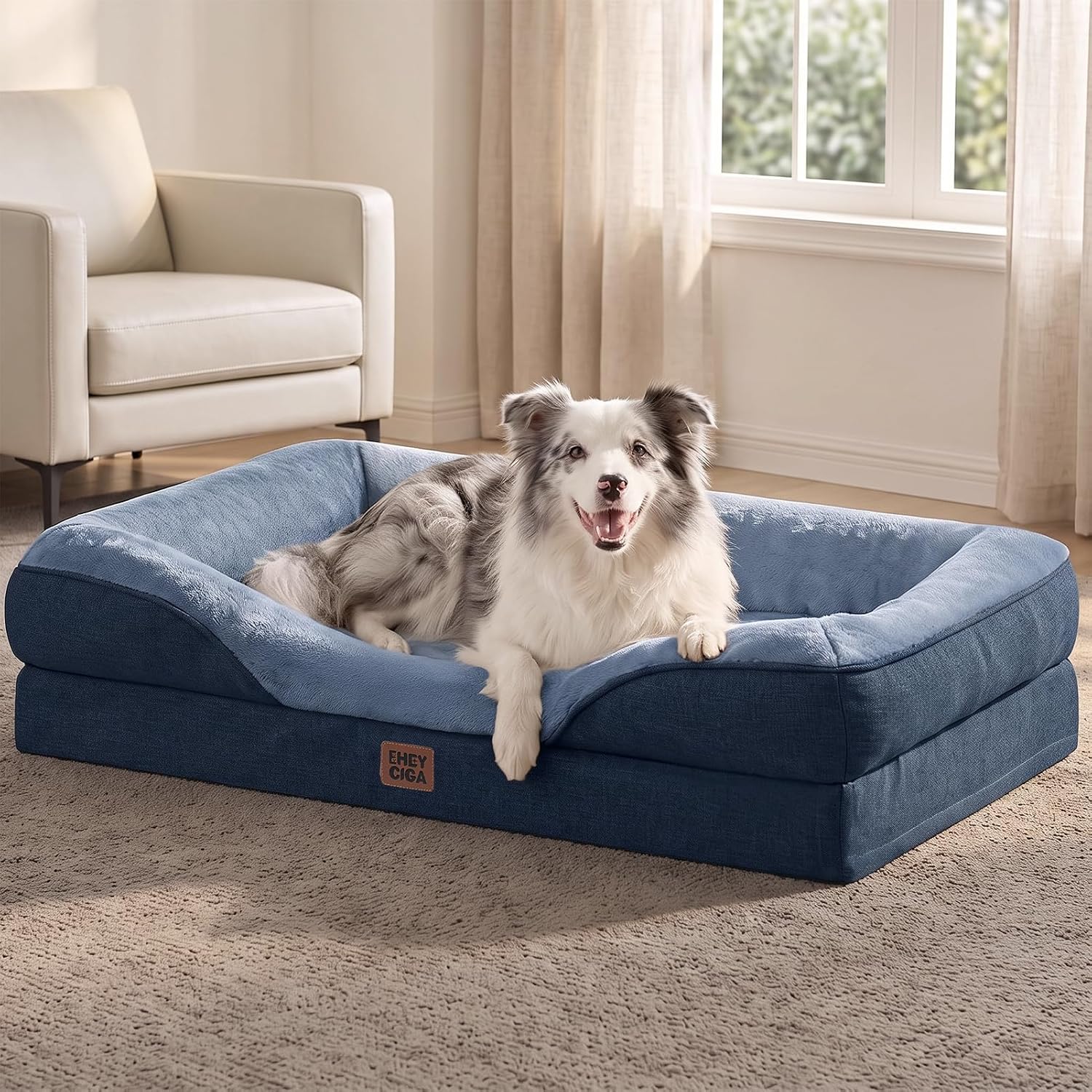
Budget pick: EHEYCIGA Orthopedic XL Dog Bed for Large Dog, Memory Foam Dog Couch, Navy
 Visit on Amazon →
This is the couch style orthopedic bed in XL, and it is the one I suggest when a lab owner wants memory foam support without spending senior-dog money. It is an XL footprint with a memory foam base, and the navy cover is a lot easier to live with than the cream and beige beds that show every muddy paw print from October through April.
The couch shape matters for labs more than people expect. A low back and raised sides give a lab something to lean against, which is how a lot of them sleep, pressed up against a wall or a couch. Duke will take a couch style bed over a flat mat every single time, and he is not a dog who curls.
Where it fits: a lab in the 55 to 80 pound range who sleeps stretched out, a household that wants a washable cover, and anyone who is not ready to spend senior-dog money on a dog who is still in the shark phase.
Flaws but not dealbreakers: An XL couch bed is not a 60 by 48 flat mat, so a very large male lab may still hang off the end. Measure against the tape rectangle before you order. And as with any foam bed, the cover is the part that wears out first, so keep the zipper clean and wash it before it gets crusty.
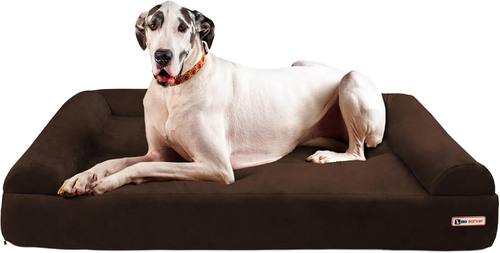
Upgrade pick: Barker Beds Giant Orthopedic Dog Sofa Bed - 7" Pillow Top with 3-Sided Bolster - 100-300 lbs - Memory Foam for Joint Pain & Arthritis - Vet Recommended, Washable - Made in USA - 60"x48"x7" - Chocolate
 Visit on Amazon →
This is the bed I recommend for a senior lab, and it is the one I would buy for Penny if I were starting over. The listing describes it as a 60 by 48 inch sofa with a 7 inch pillow top and a 3 sided bolster, rated for dogs from 100 to 300 pounds, made in the USA, with a washable cover and memory foam aimed at joint pain and arthritis. It is also described as vet recommended, which lines up with what Dr. Alvarez tells me about joint support in this breed.
The 7 inch pillow top is the number that matters here. A 7 inch stack of foam gives a heavy dog room to sink without bottoming out onto the floor, and bottoming out is exactly what makes a lab's shoulder and hip joints ache after a night on a thin bed. The 3 sided bolster gives a senior dog something to brace against when he stands up, which sounds like a small thing until you watch an 11 year old lab try to get off a flat mat on a hardwood floor.
Where it fits: a lab over 100 pounds, a senior with hip dysplasia or arthritis, a dog who has already earned a real bed. The 60 by 48 footprint is honest for a giant breed and generous for a standard lab, so Duke has room to sprawl without hanging a paw off the edge.
Flaws but not dealbreakers: This bed is heavy and it is a piece of furniture. You need the floor space and you need to be able to lift it for vacuuming underneath. The cover is washable, but a 7 inch foam core takes a while to dry if you wash the whole thing, so unzip the cover and wash only the cover whenever you can.
The setup workflow, step by step
Buying the bed is half the job. Here is how I set one up so it actually gets used.
Step one: unbox and let the foam breathe. Foam that has been compressed in a box needs time to come back. Give it 24 to 48 hours in a warm room before you judge it. A bed that looks thin on day one often looks right on day three.
Step two: put it where the dog already sleeps. Do not put the new bed in the corner you picked out. Put it where your lab already lies down, then move it a few inches a week if you want it somewhere else. Labs are creatures of habit, and a bed in an unfamiliar spot gets ignored.
Step three: make the bed boring and the chew toy interesting. This is the trainer answer to chewing, and it is the only one that works. If your lab starts mouthing the new bed, redirect him to a toy, praise the toy, and do not turn the bed into a tug game by pulling it away. That is the behavior loop: chewing gets redirected, not punished.
Step four: keep a chew timeline in your head or on paper. Write the date you bought the bed on the tag. If your lab starts digging at a seam, you will know how many weeks it lasted, and you will stop buying that brand. That is how the notebook works, and it is why I can tell you which covers survive.
Step five: wash the cover correctly. Unzip it, close the zipper before it goes in the machine so the teeth do not snag, wash cold, and air dry or use low heat. Hot water and high heat are what shrink covers and warp zippers. The zipper is the first thing to fail on any bed, and it fails in the dryer, not on the dog.
Step six: check for flattening every month. Press your palm into the foam where your lab sleeps. If your hand sinks to the floor with no resistance, the foam is done, no matter what the cover looks like. Flip the foam core if the bed allows it, and rotate the bed 180 degrees so the dog is not always lying on the same spot.
What does not work for a Labrador
I will save you some money here.
Donut beds are a joke for this breed. A 75 pound lab does not curl into a ball, he sprawls like a starfish, and a donut gives him a nest he cannot use. Plush beds are worse. Anything with loose stuffing and a soft shell is a chew toy with a price tag for a lab under three years old, and you will be vacuuming foam for a week.
Be skeptical of the word indestructible. I have seen the "lasted a week" reviews, and I have lived them. The material that holds up against a determined lab is a dense, tightly woven fabric, and even then the seams are the weak point, not the panels.
Finally, ignore "large" and "XL" labels entirely. Measure your dog, measure the tape rectangle on the floor, and buy the bed that matches the number. A bed that is too small for a lab is not a bed, it is a mat with ambitions.
What this all costs
The honest comparison is cost per day, not sticker price. Take what you pay, divide it by the number of days the bed actually lasts, and you have your real number. A cheap bed that dies in four months and gets replaced three times costs more than one good bed that runs for three years. That is arithmetic, not opinion.
The EHEYCIGA is the lower-cost entry point of the two, and the Barker Beds sofa is the long haul pick. Prices on both move around on Amazon, so check current Amazon price on each listing before you decide. If your lab is under three, the budget pick is the smarter buy, because the shark phase ends and the bed does not have to. If your lab is a senior with hip trouble, the 7 inch pillow top is the one that pays you back in mornings where he gets up without a hitch in his step.
The bottom line
Measure your lab nose to tail, add 12 inches, and tape that rectangle on the floor before you buy anything. Then buy the densest foam you can afford in a cover you can wash, and keep the zipper alive by washing cold and air drying. Do that and you skip the tuition most lab owners pay on three beds before they get it right.
Your lab will spend more hours on this bed than on any piece of gear you own. Measure once, buy once, and let him sleep.