Most labrador dog bed advice comes from people who have never watched a 75-pound lab treat a bed like a chew toy with a price tag. A bed fails in one of two ways in my house: Duke destroys it, or it pancakes under him until it is a mat with delusions. Both failures happen faster than the copy on the box admits.
I have put more than 40 beds under two very different labs. Duke is 75 pounds, five years old, a black lab who chews first and asks questions never. Penny is 55 pounds, 11 years old, a rescue with hip dysplasia who needs pressure off her joints more than she needs armor plating. Two standards, one house, and a notebook full of foam sink depths and failure dates.
This is how I pick and set up a labrador dog bed, from the tape measure to the washing machine. It covers the two beds in this guide, what each one is actually good for, and the steps I would walk any lab owner through before they spend a dollar.
Why you should trust me
I spent 10 years as a dog trainer before I started writing full time, most of it with hunting labs and obedience dogs. Kennel owners destroy gear faster than any family home, and a field lab treats a bed like something to be conquered. That job taught me to read the dog before the label.
Since then I have kept a notebook on every bed that comes through the door: how deep the foam sinks under a 75-pound dog, how long the cover survives, the day the zipper dies. I have cut beds open to check what is inside, because the marketing words and the foam do not always match. I do not take money to change a verdict, and if a brand sends a product I say so.
What I will not do is play vet. Dr. Alvarez, my vet, told me she sees more joint problems in labs than in any other breed. That is why the senior-dog advice in this article leans hard toward dense foam and a low entry height.
How I picked and how I tested
Two beds are in this guide, and they sit at opposite ends of the size spectrum on purpose. One is a compact orthopedic bed with a waterproof lining. The other is a 71-inch memory foam sofa built for a dog who sleeps like a starfish, legs everywhere, taking up half the living room.
The filters I run every bed through:
Foam density. Memory foam is measured in pounds per cubic foot. Cheap stuff runs 1.5 to 2, and it pancakes under a lab within a few months. Dense orthopedic foam runs 3 to 4. If a listing will not tell you the density, that is an answer too.
Honest sizing. Measure your lab from nose to tail and add 12 inches. A lab sprawls flat, he does not curl into a donut. "Large" on a product page means nothing until you check the inches.
Cover and zipper. The zipper dies first. I have broken more of them than I can count, and a cover that cannot survive the washing machine turns a good bed into a smelly one.
Age. A lab under 3 is in the shark phase, and no amount of training fixes a two-year-old's jaw. Cheap bed now, good bed later, every single time.
Entry height and support. For a senior lab with hip dysplasia, a low, firm edge beats a tall bolster. Penny steps onto a bed, she does not hop.
The two beds in this guide
One is a small-footprint support bed for young dogs and tight spaces. The other is an oversized sprawl platform for a big lab or a senior who needs room to stretch. Read the sizes carefully, because that is where most lab owners get burned.
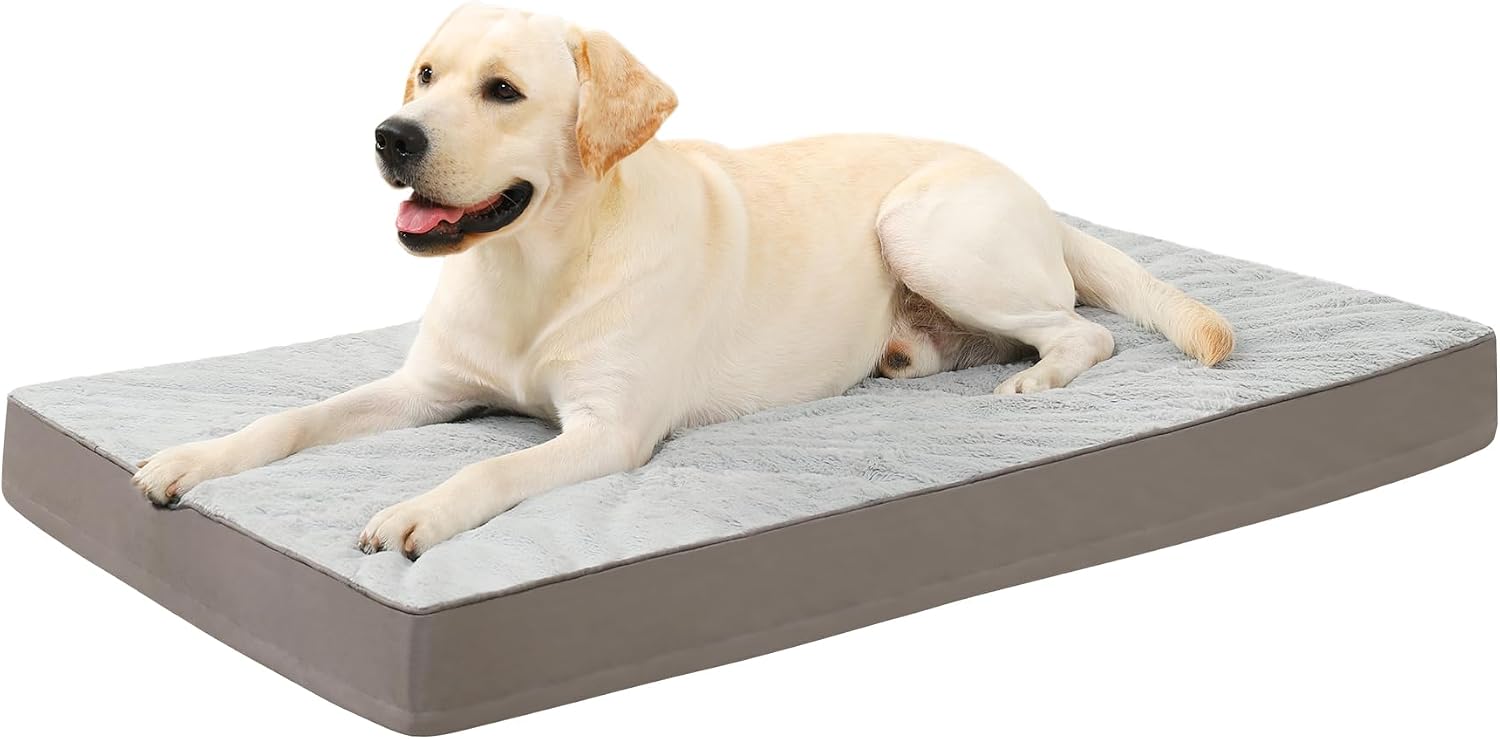
Budget pick: KSIIA Orthopedic Dog Bed for Large Dogs with Waterproof Lining, Grey, 35x22
 Visit on Amazon →
This is the bed I point lab owners toward when the dog is young, small, or still in the accident-prone stage. The waterproof lining is the feature that earns its keep. A puppy in the middle of house training, or a senior lab who leaks a little in his sleep, turns a normal bed into a laundry project, and a waterproof liner keeps the foam out of that equation entirely. The grey cover is plain enough to live in a living room, and the compact footprint slides next to a couch or into a crate corner without rearranging your furniture.
The catch is right there in the measurements. A 35 by 22 footprint is not a bed for a sprawled-out 75-pound lab, and anyone who tells you otherwise is selling you a mat. Duke would hang off both ends. This is a bed for a smaller lab, a young dog still growing into his frame, or a second bed for the spot where your lab likes to nap while you work.
Flaws but not dealbreakers: The footprint is the real limitation, and orthopedic foam at this price point will not be the dense 4-pound material you would buy for a senior dog. It is a support bed, not a joint-therapy bed.
Who it is for: puppy owners, smaller labs, and anyone who wants a waterproof, washable bed in a tight space without spending real money.
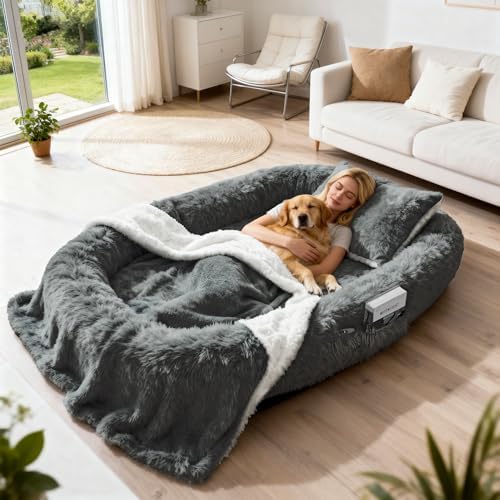
Upgrade pick: 71" Human Dog Bed for Adult, Giant Orthopedic Memory Foam Dog Sofa Bed, Large Oversize Washable Faux Fur Pet Couch with Plump Pillow, Blanket, Strap - Dark Grey
 Visit on Amazon →
Seventy-one inches is the number that matters here. That is longer than most labs are nose to tail, which means a big dog can stretch out flat, legs in four directions, without hanging over an edge. This is the starfish bed, and if you have ever watched a 75-pound lab sleep, you know why that matters. The memory foam base is the orthopedic layer, the cover is washable faux fur, and the bed ships with a plump pillow, a blanket, and a strap so you can drag the whole thing across the floor without dislocating a shoulder.
For Penny, the appeal is the platform itself. A wide, low surface means she steps in instead of hopping, and she can shift her weight off the bad hip without fighting a bolster. The washable cover is not a small detail either. Faux fur collects hair and smell, and a cover you can pull off and wash keeps a senior dog's bed from becoming the reason the room smells.
Flaws but not dealbreakers: Faux fur is a comfort material, not a chew-proof one. A lab under 3 will treat that cover as a project, and you will be vacuuming fluff. A bed this size also takes up serious floor space, so measure the room before you commit.
Who it is for: senior labs, oversized sprawlers, and owners who want one big bed that a lab and a person can both flop onto.
The actual setup workflow
This works for any lab, any bed, any budget. Do it in order and you will not be the person buying a third bed in eight months.
Step one: measure your lab, not the dog on the box. Get him flat and relaxed, then run a tape from his nose to the base of his tail. Add 12 inches. That is your minimum bed length. A lab that sleeps like a starfish needs the full number, not the curled-up estimate.
Step two: weigh him and pick the foam tier. A lab at 55 to 80 pounds needs dense orthopedic foam to keep his elbows and hips off the floor. If a listing will not tell you the density, assume the cheap tier and price it accordingly.
Step three: match the bed to the age, not the photo. Under 3 years old means the shark phase. Buy the affordable, washable bed now and save the dense orthopedic investment for the dog who has stopped eating furniture.
Step four: check the cover and the zipper before you buy. A waterproof lining matters for puppies and seniors. A removable, machine-washable cover matters for every lab, because labs shed and labs smell. If the zipper looks flimsy in the photos, it will fail first.
Step five: put the bed where the dog already sleeps. Do not pick the spot you like. Watch where he collapses after dinner and put the bed there. Beds that get moved get ignored.
Step six: make the bed boring and the chew toy interesting. This is the behavior part, and it is the part training actually solves. If your lab is chewing the bed, the bed is not the problem. Redirect him to a toy he is allowed to destroy, reward him for choosing it, and keep the bed out of reach when you cannot supervise. A puppy is not chewing to be bad. He is chewing because chewing is what puppies do.
Step seven: check for pancaking every 60 days. Press the foam flat with your hand and let go. If it springs back, you are fine. If the dent stays, the foam has given up and you are now the owner of a pancake. That is your signal to replace, not repair.
One caveat that saves people money: skip anything sold as "indestructible" to a lab owner with a young dog. No fabric beats a determined two-year-old lab, and the warranty usually requires a notarized confession of your dog's crimes.
The competition and why it lost
Donut beds are a joke for labs. A 75-pound lab does not curl up, he sprawls like a starfish, and a donut just gives him a rim to chew. Plush bolster beds with loose stuffing are worse. Under 3 years old, a lab will open a seam and you will be vacuuming foam for a week.
In my own house, K9 Ballistics is the only bed Duke has not destroyed over 14 months, and the chew-proof guarantee is real, they replaced a cover for me with no questions and no shipping costs. Big Barker is the bed I recommend for a senior lab, and Penny's morning limping improved measurably on it. Orvis has the only zippers I have seen survive 20-plus washes, though the foam is mediocre. Those beds are not in this guide, but they are the reason I set the bar where I set it.
What this all costs
Here is the arithmetic that matters more than any sticker. Divide the price you see today by the number of usable days. A bed that dies in four months costs more per day than a bed that lasts three years, even when the second one costs several times more up front. That is not opinion, that is division.
The cheap bed is the most expensive option when you buy it three times. Every lab owner makes the $60 mistake once. The smart ones only make it once, and then they buy the right bed for the dog in front of them: the affordable washable bed for the puppy, the dense orthopedic platform for the senior.
Start with the tape measure. Measure the dog, check the foam, check the zipper, and put the bed where he already sleeps. Do that and you will buy one bed instead of three.