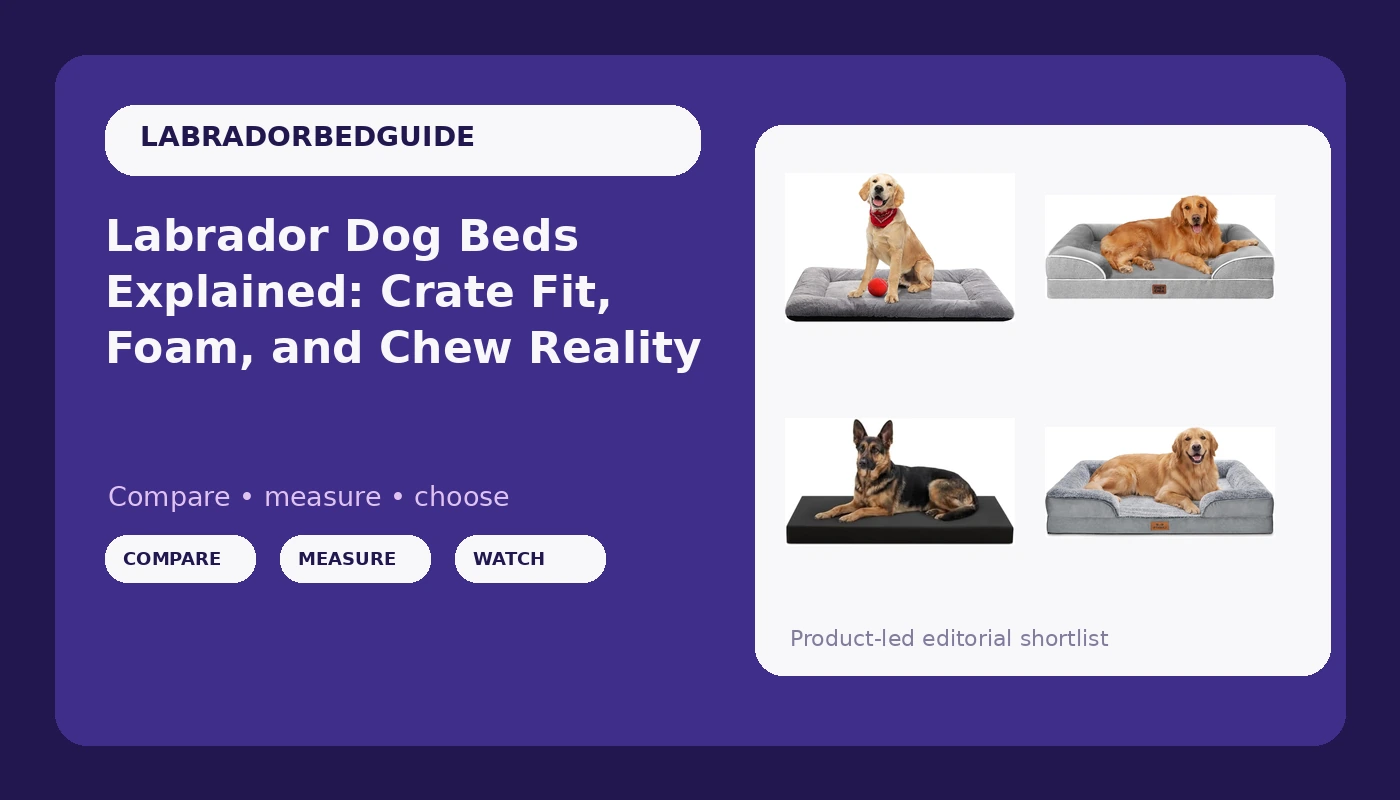
Most labrador dog beds fail in one of three ways: the crate pad is too thin to cushion a 75-pound dog, the orthopedic foam flattens into a pancake within a season, or the cover turns into confetti during the shark phase. Labs are a specific problem in the bed aisle. They sprawl like starfish instead of curling into a ball, they carry real weight through the hips, and plenty of them chew first and ask questions later. That combination rules out a big share of what gets sold as a "large" bed.
This explainer walks through four labrador dog beds at four different price points and explains what each one is actually for: crate fit, foam type, cover material, and how to decide which of those matters most for your dog right now.
Related: How to Measure a Labrador for a Crate Bed →
Quick answer
Match the bed to the job, not to the product photo. If the bed lives in a crate and your lab is rough on fabric, the K9 Tough Ripstop Orthopedic Crate Bed is the one built around a ripstop shell. If you want an extra-large orthopedic bed with a waterproof, washable cover, look at the EHEYCIGA Orthopedic Extra Large Dog Bed. If your lab sprawls flat and you want a sofa-style base, the Memory Foam XL Dog Bed Couch is the couch-shaped option. If you need an inexpensive mat for a medium crate, a puppy, or a spare setup, the 36-inch washable crate pad is the entry point.
Four useful options
| Model | Best fit | What stands out |
|---|---|---|
| K9 Tough Ripstop Orthopedic Crate Bed, 47 x 29, Obsidian Black | Crate sleepers and dogs that chew | Ripstop cover on an orthopedic crate bed in a 47 x 29 footprint |
| EHEYCIGA Orthopedic Extra Large Dog Bed, Waterproof Washable XL Pet Bed 44" | Extra-large sleepers, accidents, muddy paws | Waterproof, washable cover on a 44-inch orthopedic XL bed |
| Orthopedic Extra Large Dog Bed, Memory Foam XL Dog Bed Couch, 44" L | Sprawlers and couch sleepers | Memory foam base in a 44-inch couch-style XL bed |
| Dog Crate Pad Washable Dog Bed for Crate Medium Cozy Mat 36-Inch Gray | Medium crates, puppies, spare beds | Washable 36-inch crate mat in gray |
Durability pick: K9 Tough Ripstop Orthopedic Crate Bed, 47 x 29, Obsidian Black
Ripstop is not magic, but it behaves differently from plush. Once a plush cover gets a nick, the tear runs. A ripstop weave is built with a grid of reinforcing threads that stops the run, which buys you time and gives you a cover that can survive a determined jaw long enough to matter. The trade-offs are real: a fabric this tough feels firmer than a fleece-topped bed, and it usually costs more than a standard orthopedic crate bed. For a lab under three years old, that is money well spent, because the alternative is buying the same bed twice.
Waterproof XL: EHEYCIGA Orthopedic Extra Large Dog Bed, Waterproof Washable XL Pet Bed 44"
Waterproofing is the feature people skip and then regret. A senior lab has accidents. A young lab comes in from the yard with wet feet and a wet belly. If moisture reaches the foam, you get a smell that no amount of surface washing fixes, and the bed gets thrown out long before the foam has worn out. A waterproof cover changes the cleaning routine from "replace the bed" to "unzip the cover and wash it." The trade-off is breathability: waterproof layers run warmer, so a lab that overheats in summer may prefer this bed in cool weather and a plain mat in July.
Couch style: Orthopedic Extra Large Dog Bed, Memory Foam XL Dog Bed Couch, 44" L
Memory foam is the right material for a lab that sleeps flat and heavy, because it spreads the dog's weight instead of compressing into a hard spot under the hips. The couch shape also solves a small problem: a starfish sleeper with a defined back edge has something to lean into, so he is less likely to slide off a flat mat onto the floor at 2 a.m. The trade-off here is the cover. Couch-style beds are usually the first thing a bored chewer attacks, because there is more fabric to grab, so this is a bed for a dog past the shark phase or for a household where the bed is not left alone with a two-year-old lab.
Budget crate pad: Dog Crate Pad Washable Dog Bed for Crate Medium Cozy Mat 36-Inch Gray
This is not an orthopedic bed and it should not be sold as one. It is a crate mat: a washable layer between your dog and a hard crate pan. That is exactly what a puppy needs, because a puppy will destroy a good bed, and the honest move is to spend little now and buy the dense foam bed after the chewing settles down. It also works as a second bed in the car, a travel mat, or a washable layer on top of an older bed that has lost its cover.
Prices and availability may change. Product images, names, and retailer links are matched to verified listings. No current price, rating, stock status, or measured result is stated here without current evidence.
Crate fit: measure the crate, not the breed label
Sizing is where most lab owners get burned, and it has nothing to do with whether the label says large or XL. A crate bed has to match the crate floor, not the dog's weight class. Measure the inside of the crate from wall to wall, front to back, then compare that against the bed's listed dimensions. A 36-inch mat is a medium-crate product. A 44-inch bed and a 47 x 29 bed belong in a larger crate or on the floor.
For a lab sleeping outside a crate, the number that matters is nose to tail plus roughly 12 inches of margin. A 75-pound male lab stretched out flat covers more floor than most people expect, which is why "large" beds that fit a 40-pound dog end up being slept on halfway, with the hips hanging off the edge. That is also why donut beds rarely work for this breed. A lab does not curl. He sprawls.
Foam, covers, and the chew timeline
Foam quality is not visible in a product photo, so check how the base is described. Memory foam and orthopedic foam bases hold shape longer than loose fill or a thin batting pad. Shredded fill compresses into lumps under a heavy dog within months, and a pad with almost no loft gives a lab's elbows nothing to rest on.
Then look at the cover, because the cover fails first. Ripstop and similar tight weaves resist tearing; thin plush invites it. Zippers are the next failure point, and they usually die in the washing machine, so check whether the cover zips off and whether the listing describes it as machine washable. Waterproof liners matter for seniors and for any dog that comes in wet. A chew timeline is the honest way to think about all of this: plush covers on a determined lab are measured in weeks, tougher weaves in months or years.
- Measure the inside of your crate wall to wall and front to back before you shop.
- For a floor sleeper, measure nose to tail and add about 12 inches of margin.
- Confirm the base material: memory foam and orthopedic foam over loose fill or thin batting.
- Confirm the cover is removable and machine washable, and check whether it is waterproof.
- Match the cover toughness to your dog's age, since a lab under three will chew almost anything.
Practical rules for buying a lab bed
- Buy cheap while your lab is in the shark phase, then buy dense foam once the chewing stops.
- Add up cost per day before you decide, because three cheap beds can cost more than one durable bed.
- Treat "indestructible" as marketing until you see a weave described as ripstop or ballistic.
- Put a washable mat on top of an expensive bed to keep the original cover out of the laundry.
- Weigh joint support against durability: a senior lab with hip trouble needs foam density more than a tough cover.
Which option should you choose?
Choose the K9 Tough Ripstop Orthopedic Crate Bed, 47 x 29, Obsidian Black when the bed lives in a crate and durability is the deciding factor. Choose the EHEYCIGA Orthopedic Extra Large Dog Bed, Waterproof Washable XL Pet Bed 44" when accidents, drool, or wet coats are part of daily life. Choose the Orthopedic Extra Large Dog Bed, Memory Foam XL Dog Bed Couch, 44" L when your lab sprawls on the floor and you want a couch-shaped memory foam base. Choose the Dog Crate Pad Washable Dog Bed for Crate Medium Cozy Mat 36-Inch Gray when you need a washable mat for a medium crate, a puppy, or a spare room.
One caveat: the cover materials described here come from the product listings, not from a lab test. Firmness, foam density, and how long a cover holds up against a specific dog vary, and the only way to know for your own lab is to watch how he treats the bed in the first month. If he starts working on a seam or a zipper, that is your answer, and no warranty language changes it.
The bottom line
There is no single labrador dog bed that fits every dog, because a nine-week-old puppy and an eleven-year-old lab with hip dysplasia need opposite things. Puppies need cheap and washable. Adult chewers need ripstop and a crate-sized footprint. Seniors need dense foam and a cover that survives the laundry. Buy for the dog in front of you today, and expect to buy again when that dog changes. Check current Amazon price on each option and compare the cost per day, not the sticker.